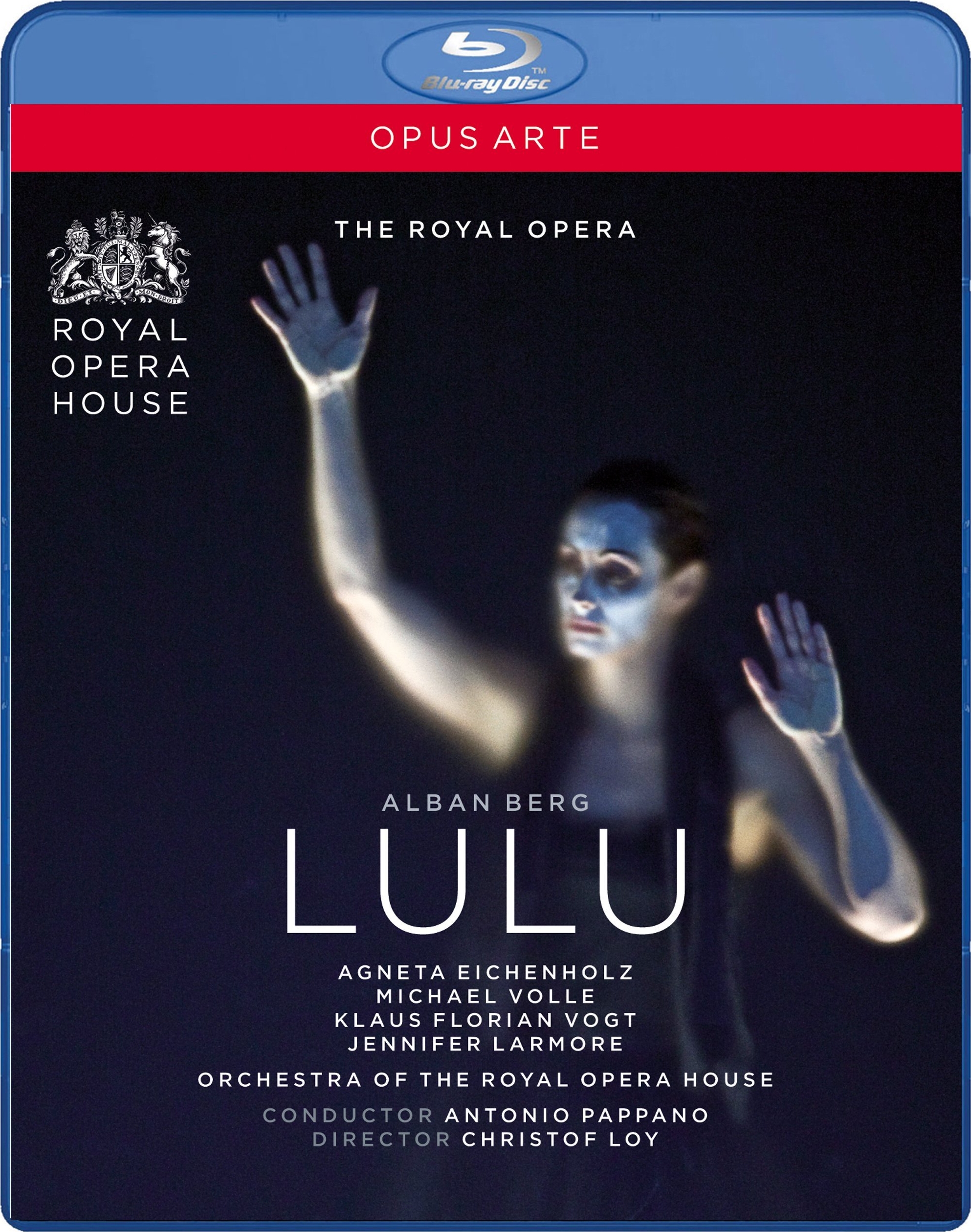
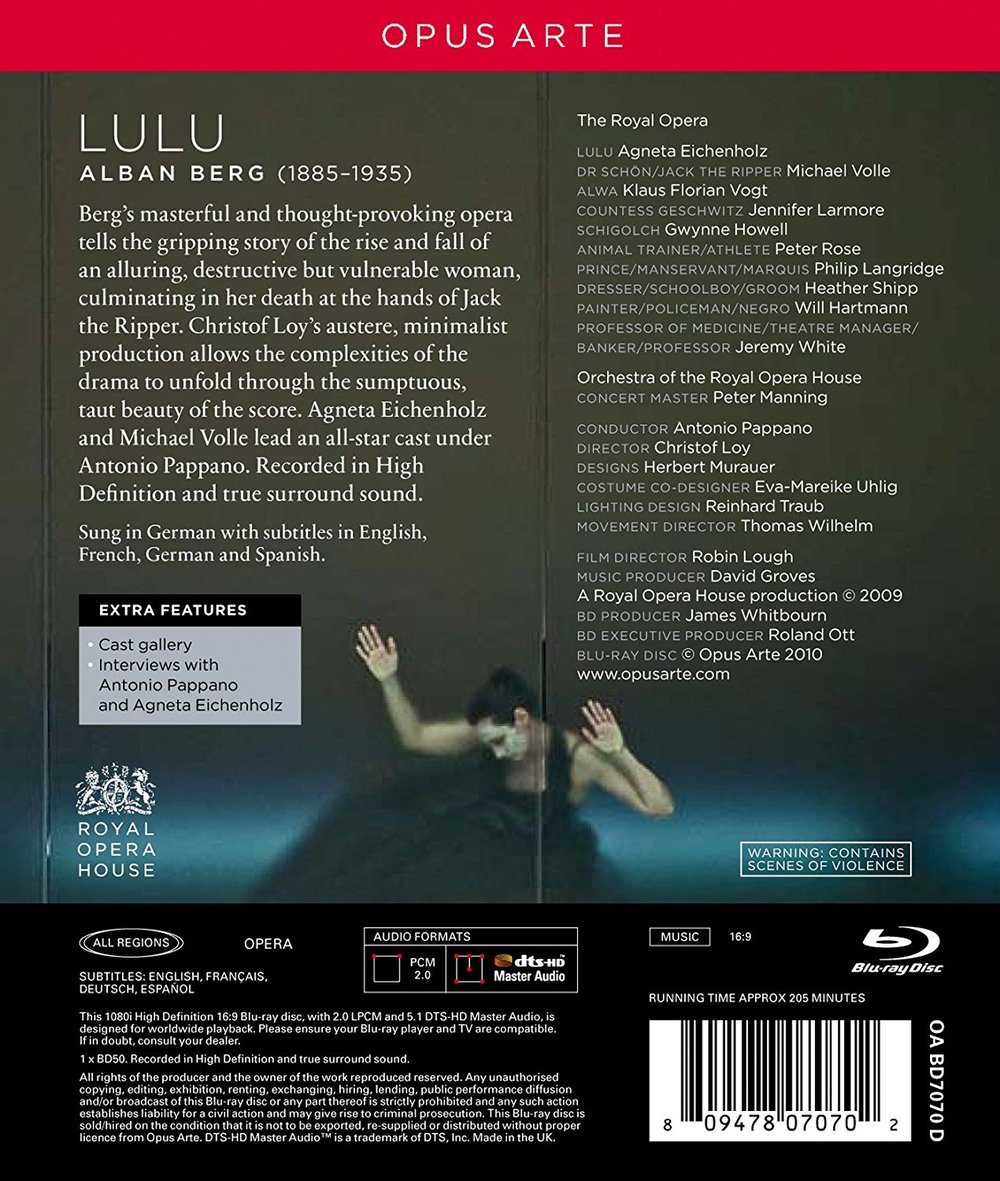
Berg Lulu opera to a libretto by the composer. Directed 2009 by Christof Loy at Royal Opera House. Stars Agneta Eichenholz (Lulu), Michael Volle (Dr. Schön/Jack the Ripper), Klaus Florian Vogt (Alwa), Jennifer Larmore (Countess Geschwitz), Gwynne Howell (Schigolch), Peter Rose (Animal Trainer/Athlete), Philip Langridge (Prince/Manservant/Marquis), Heather Shipp (Dresser/Schoolboy/Groom), Will Hartman (Painter/Policeman/Negro), Jeremy White (Professor of Medicine/Theater Manager/Banker/Professor), Kostas Smoriginas (Journalist), Vuyani Mlinde (Manservant), Monika-Evelin Liiv (Gallery Owner), Frances McCafferty (Mother), and Simona Mihai (15-year-old Girl). Antonio Pappano conducts The Orchestra of the Royal Opera House (concert master Peter Manning). Designs by Herbert Murauer; costumes by Eva-Mareike Uhlig; lighting by Reinhard Traub; movement direction by Thomas Wilhelm; music produced by David Groves. Directed for TV by Robin Lough. Sung in German. Released 2010, disc has 5.1 dts Master Audio sound. Grade: C+
This Lulu was reviewed as a live show in the September 2009 Opera News by George Hall. He praised the orchestra and conductor while warning of the minimalist design. Colin Anderson in the July/August International Record Review discusses the live performance and the DVD in a full-page essay. He states this was a "production ripe for filming" and generally supports it.
Lulu in its Cerha version was first performed in 1979. It a long, complicated, and sophisticated work with challenging modern music. Someone said an opera is a play where people sing about sex and violence. That definition fits Lulu. But this is not in another sense a normal opera, which usually has a cast of characters (included at least one you care about), a conflict, a climax, and an happy or sad ending. Lulu has a lot of characters, and you don't care about any of them. Instead of a conflict/climax/resolution there is a long string of disasters. But is still fascinating to see how most everybody comes to ruin.
Well, if you were to care about any character in this opera, it would be Lulu. She was abused as a child by her mysterious father Schigolch and by Dr. Schön, who took her off the streets at age 12 as a protégé and target of opportunity. The abuse set her on a path of amorality and promiscuousness that eventually led to her death. Along the way Dr. Schön, his wife, and his son are all murdered and a number of other people also die before their time. But I don't think this opera is really about a ruined girl—to me it's a satire (somewhere between morbid and mordant) in which Berg skewers just about everything, including Lulu the opera itself.
So now you maybe get the picture: this is a comedy. From what I can tell from recordings, people don't laugh at this in the opera house. But in a home theater, with good subtitles you get how clever and sarcastic the libretto is. I laugh at this a lot, and loud! If I did this in a theater, somebody might glare at me or tap me on the shoulder. But at home I can laugh all I want.
We now have two productions of Lulu: a colorful, "rich" Salzburg show and this polar opposite, an almost black-and-white, Spartan Royal Opera House production. So let's briefly discuss the pros and cons of both, and use the this mini-review for both of them.
In the Salzburg version, Veri Nemirova is quite successful in supporting the singing and acting with sets, costumes, and props that help make sense of the dense libretto. A newcomer to the opera with the aid of a synopsis has a fighting chance of following the pageant of calamities. Taking mercy on the viewer, Nemirova avoids injecting surreal or bafflingly clever elements in the show. Then "Large takes charge" to give the home viewer a dazzling video with superb picture quality and picture content.
Maybe the most confusing part of this opera is Act II, scene 1, after Dr. Schön marries Lulu and his home life disintegrates into chaos. Nemirova manages with the use of skillful visual images to get me through this. In contrast, I find this scene in the ROH version to be baffling. I also liked the way Nemirova and Large depict the Act III, scene 1 Paris party scene 98% in the midst of the audience. It took a lot of nerve and skill to bring this off, and this change of approach helps avoid the onset of monotony in this long opera. But the dull look of the ROH show stays the same for 3 hours, enough to wear out all but the most fanatical opera fan.
The severe mise-en-scene of the ROH show puts a huge burden on the singers to act out the libretto intelligently. This burden is increased by the fact that many cast member play 2 to even 4 different characters, which can lead to audience confusion. Fortunately, the cast is superb, and they troop on magnificently.
But director Loy then throws too many curves at the cast and audience. For example, in Act I, scene 2 the painter goes into another room (to cut his throat). Schön then calls for an axe to batter down the door. Loy leaves the painter on the stage in the midst of the other singers. But the business with the axe stays in as well, which makes no sense unless (1) you know the opera really well, (2) stay on your toes, and (3) figure out fast that Loy is trying to make you look like a fool. At the end of the opera, Lulu as prostitute has three customers. She had 3 husbands. The first customer is played by the same actor who played her first husband, etc. OK, when the second customer appears, you see he is played by the same actor who played the painter. But he still has the same blood on his shirt that we saw when he cut his throat as the painter. The problem is that this is inconsistent with the character of the second customer. (He is a tough customer, but Johns don't walk in covered with blood). This depiction of John 2 is Eurotrash cuteness, which deserves to called out.
At this point I've done enough to register my irritation at the ROH directing. A should also mention that the ROH orchestra and Pappano do a magnificent job with the music. And the ROH disc has German subtitles. If you work hard enough, you can make sense out of this show notwithstanding the weak direction.
In summary, if you are just starting to learn Lulu, the Salzburg version is a vastly better choice for you than this ROH version. The ROH version would be a good choice if (i) you want to focus on the orchestra or (2) you are already an expert on Lulu and are tired of the more gaudy versions you have seen. Now on to some screenshots; many of these can be compared to shots in the Salzburg Lulu review of the same places in the libretto. So split your screen and fire up two browsers.
Here's the prologue. Doesn't much look like a comedy. From left to right, Peter Rose is the animal trainer; Agneta Eichenholz and Michael Volle are standing at attention as Lulu and Dr. Schön:

Here's where the painter (Will Hartmann) hits on Lulu. Making this statement to a fully-clothed woman is a bit absurd. Lulu is supposed to be mostly undressed as a model for a sexy portrait:

Contrast this to my third screenshot of the Salzburg Lulu review:

The painter cuts his throat when he finds out the truth about Lulu:

Lulu closes in on Schön. I have this scene also in the Salzburg Lulu screenshots, where the director makes good use of the wedding ring to help us understand what is happening:
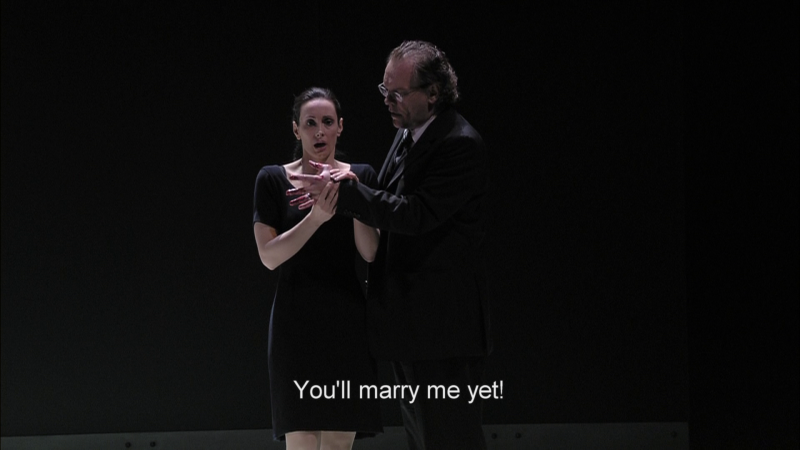

Now Lulu and Schön are married, and numerous secret admirers are appearing, including the lesbian Countness Geschwitz (Jennifer Larmore). In German, schwitzen is the verb "to sweat." I don't think "Geschwitz" is a noun in German, but the Countess will sweat a lot in her efforts to please Lulu:

There should be on stage the portrait that the painter made of Lulu before his demise. Loy assumes you know this and provides no prop at all:

A good example of Alban Berg's sarcasm. Loy's clown makeup for Schön is pure Eurotrash, but even a dummy such as I can sort of get it:

Now we get Alwa, Schön's son, in the mix (Alwa played by Klaus Florian Vogt) :
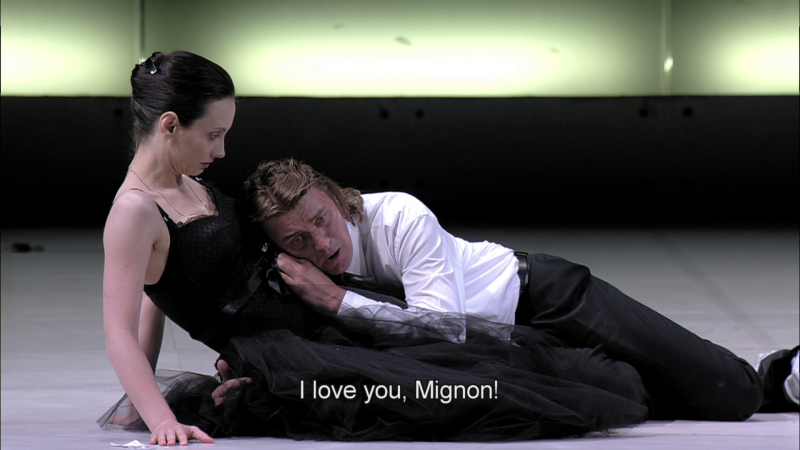

Schön is an elegant host:

Now we come to Lulu's final fight with Schön, who stupidly puts a gun in her hand so she can shoot herself:

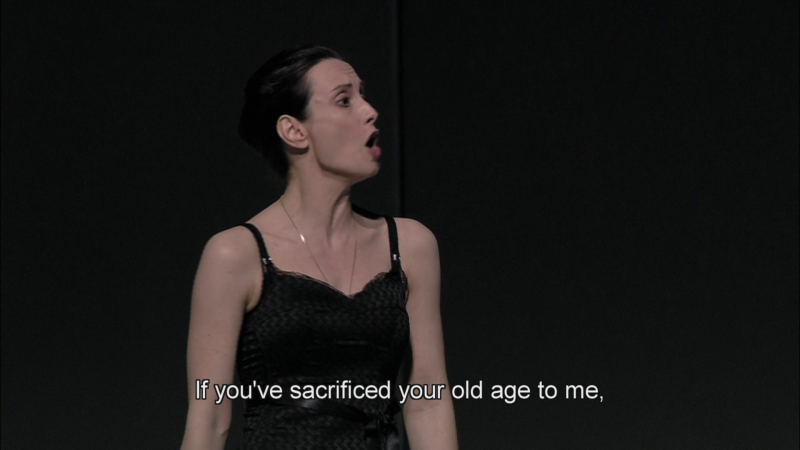

She retreats about 30 feet and deflates Schön with a series of well-aimed shots. Lulu has all the survival skills:

Can you imagine contracting cholera deliberately? That's really an unusual survival skill:

Now we are down to Act III with a whole host of new vultures circling. Unfortunately, they all look pretty much alike lined up across the stage as if already at curtain call:
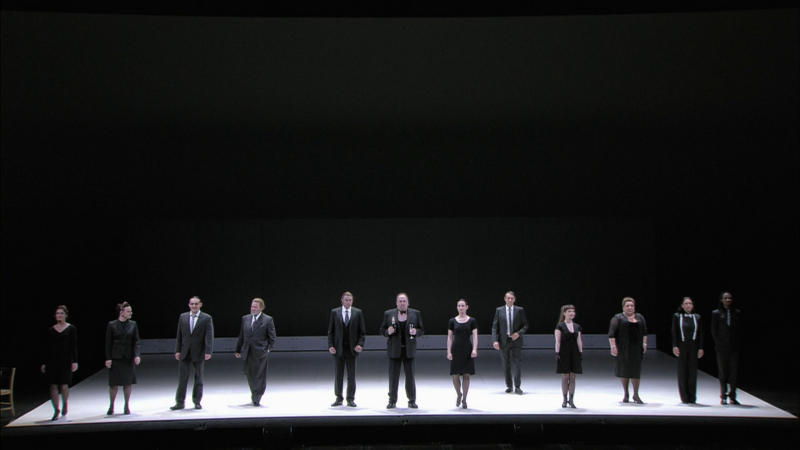
Lulu and her first client as streetwalker (Jeremy White, who also played the first husband):
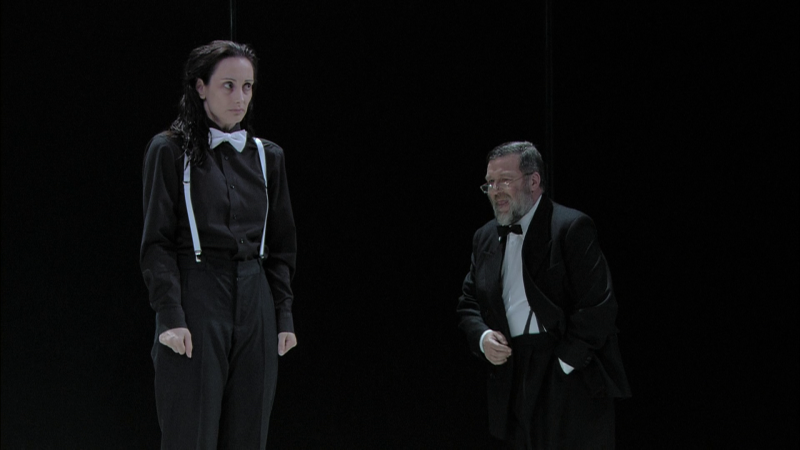
The third client is Jack the Ripper played, of course, by Volle, the third husband; the line show here is sung by Lulu:

In this production, Geschwitz is the one who resolves to make a fresh start:

Geschwitz hears Lulu screams:

You might expect Jack to snuff the witness, but he's tired. Let's hope Geschwitz gets into law school. With all her practical experience, she will probably be a star student.

I'm giving a "C+" to this ROH version on account of boring direction.
OR
