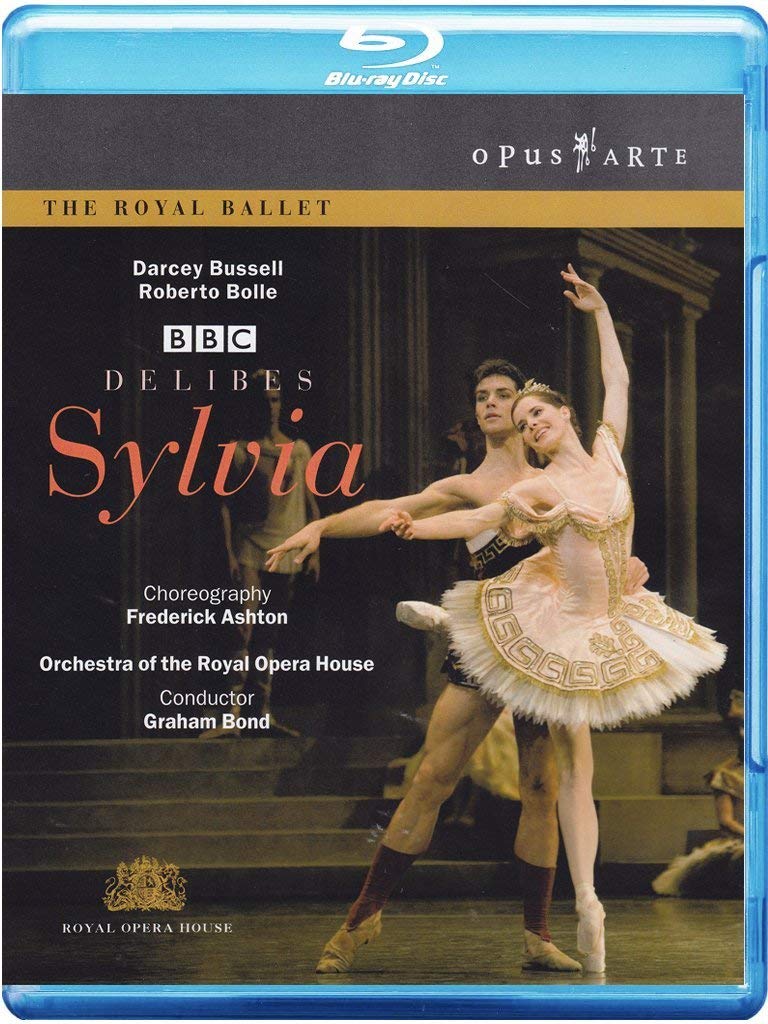
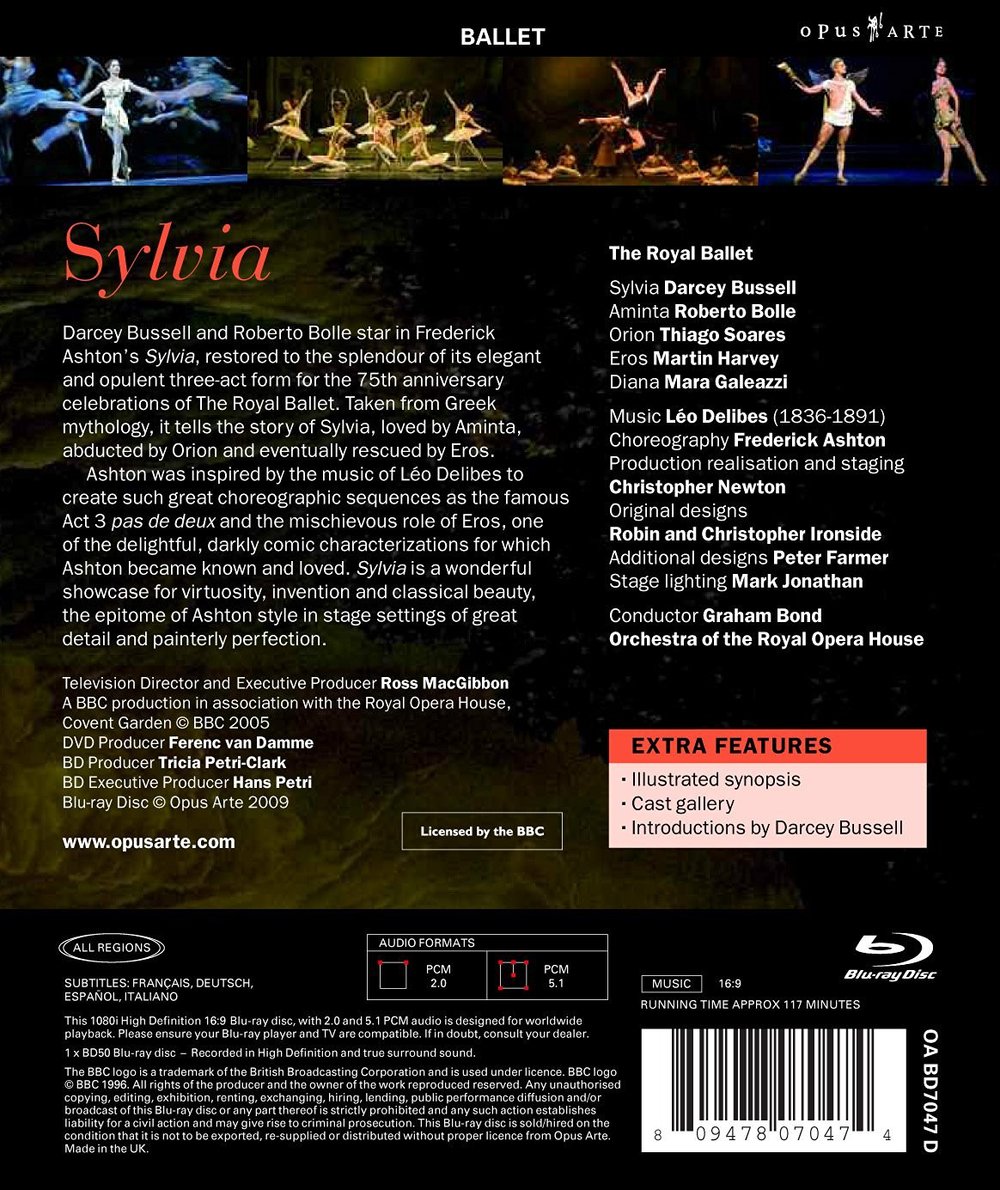
Sylvia ballet. Music by Léo Delibes. Choreography by Frederick Ashton with production realisation and staging by Christopher Newton. Performed 2005 by the Royal Ballet at the Royal Opera House. Stars Darcey Bussell (Sylvia), Roberto Bolle (Aminta), Thiago Soares (Orion), Martin Harvey (Eros), Mara Galeazzi (Diana). Sylvia's attendants are Deirdre Chapman, Lauren Cuthbertson, Victoria Hewitt, Sarah Lamb, Isabel McMeekan, Laura McCulloch, Sian Murphy, and Samantha Raine. Orion's concubines are Victoria Hewitt and Sian Murphy. Slaves are Kenta Kura and Joshua Tuifua. Goats are Iohna Loots and José Martin. Graham Bond conducts the Orchestra of the Royal Opera House (Assistant Concert Master Melissa Forshaw). Original designs by Robin and Christopher Ironside; additional designs by Peter Farmer; stage lighting by Mark Jonathan. Directed for TV by Ross MacGibbon. Released 2009, disc has 5.1 PCM sound. Grade: A-
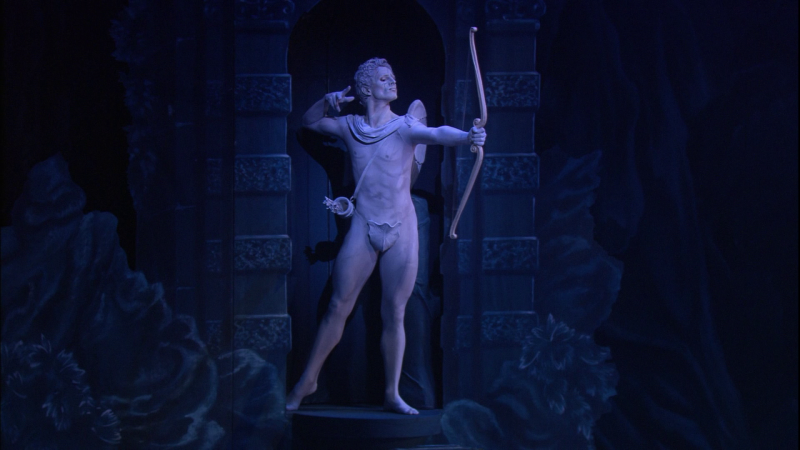
Sylvia is a relatively obscure ballet. It was created in 1876, but was mostly ignored until 1952, when Frederick Ashton devised the choreography that's been used, with updating, ever since. Per Ashton, the libretto can be stated as follows, "Boy meets girl, bad guy kidnaps girl, god gives girl back to boy." The god is Eros (Martin Harvey), a statute of whom adorns a temple in the forest. Harvey, compact and quick as a dancer, also has the ability to stand as still as a statute for long periods of time, something that must be hard for him:

All the locals cavort at the Temple of Eros. This includes Sylvia (Darcey Bussell). She is a nymph, one of those semi-divine young women who live in the hidden shadows around springs, meadows, and grottos. Nymphs prefer the company of gods, but they can also mate with humans who are attractive or bold enough to make it happen. Well, Sylvia was a chaste nymph, dedicated to the virgin goddess Diana. Sylvia and her followers like to taunt Eros:

Aminta (Roberto Bolle) is a shepherd who is in love with Sylvia. The girls catch him lurking about, and they are scandalized when he declares love for Sylvia:

Sylvia aims an arrow at the statute of Eros, but Aminta jumps in the path of the arrow, takes a hit, and falls prostrate. Eros resolves to show his power. He hits Sylvia with an arrow to the heart, and she falls madly in love with Aminta:

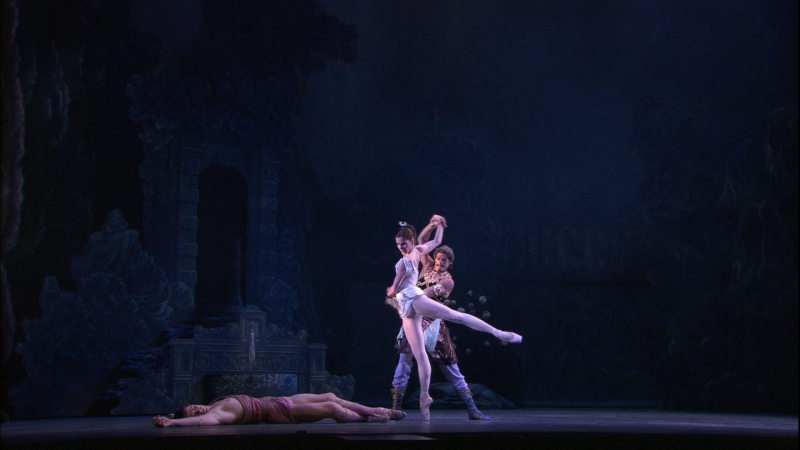
Now we meet Orion (Thiago Soares), a fearless and aggressive hunter, who lusts after Sylvia. Now that Sylvia is capable of love, Orion captures her and takes her to his hideout. Aminta is still on the ground, dead or dying:

Peasants arrive to worship Eros and find the body of Aminta. Eros rewards Aminta for his bravery by appearing in disguise. Eros heals Aminta with a magic flower:

At his hideout, Orion tries to win Sylvia over with rich gifts. But Sylvia can only think of Aminta and wonder if he is dead or alive:
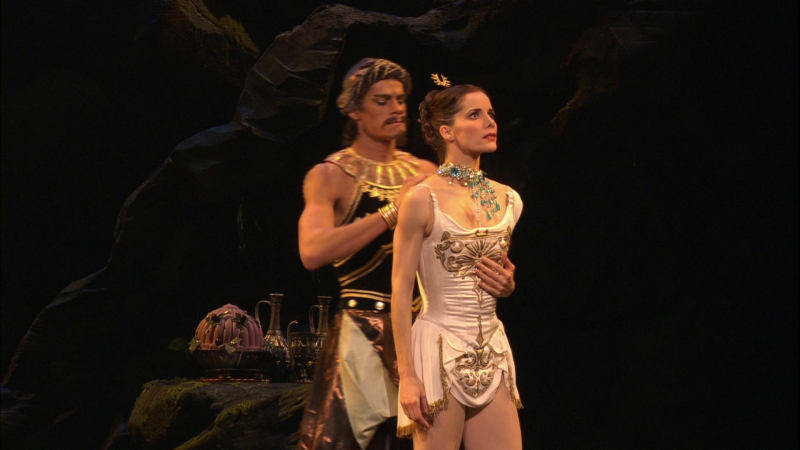
Sylvia is resourceful. She dances for Orion and his guards until they all fall into a drunken stupor:
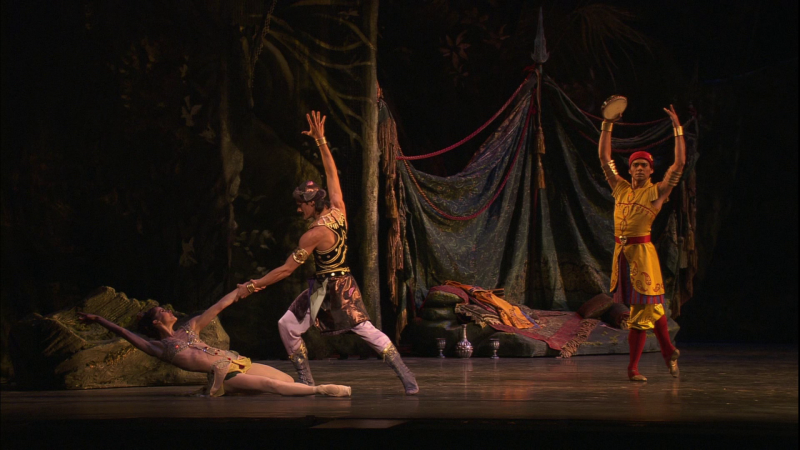
She then prays to Eros for rescue:

It's about like calling a taxi. Soon Eros appears with a boat to take Sylvia home to the Temple of Diana:

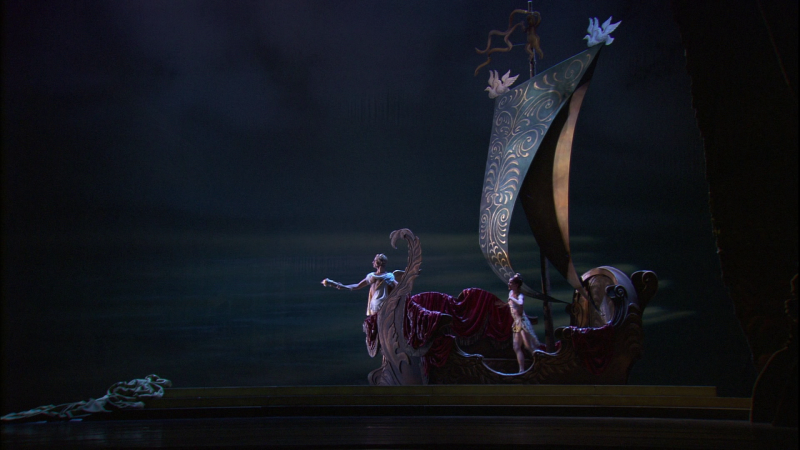
Eros and Sylvia arrive at Diana's temple in time to for a big celebration in honor of Bacchus:
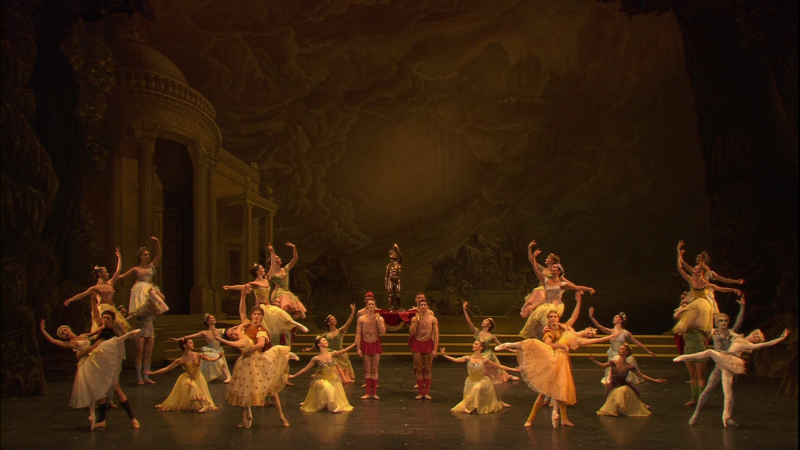
Eros gives the girl back to the boy:

Eventually Orion shows up at the party also and tries to starts a fight, but Diana drives him away. This is a lucky development for the goats (Iohna Loots and José Martin). They were originally scheduled to be sacrificed to Diana, but were spared in the confusion caused by the arrival of Orion:

The party continues with the famous Pizzicati scene and wonderful dancing by Sylvia and Aminta:
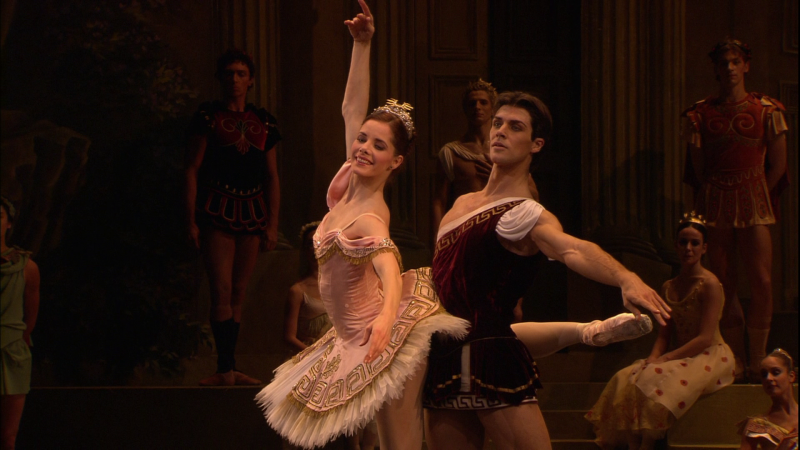
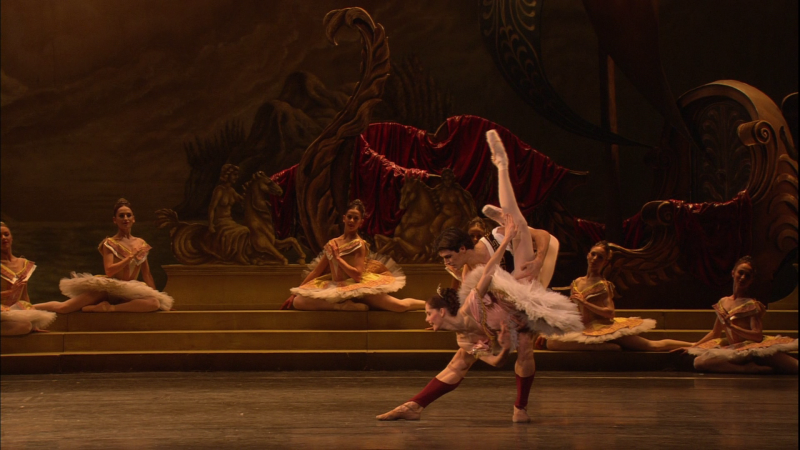

But there is still one last problem. Diana is not pleased that Sylvia has fallen for a human. But Eros has a work-around for that too. In an apparition, Eros reminds Diana that she too was once in love with a shepherd named Endymion. Diana relents and allows the lovers to have their way:

Darcey Bussell as Sylvia is sufficiently beautiful to make all this seem plausible. Any man she would fall for would have to be at least be as handsome as a god, and who is more handsome than Bolles? Thiago Soares as Orion exudes aggression with his scary eyes, odd nose, and twisted smirk. The choreography is completely satisfying. So the dancing of this wonderful cast and the much-admired Delibes score (well-played here, of course) make this show entertaining despite the simplicity of the libretto.
The scenery and costumes are executed in a way that doesn't look out-of-date or old-fashioned. The lighting is remarkable. The first act is set in gray and blue against deep shadows; the remaining acts are often flooded with an eerie orange-yellow glow. This lighting is pushed at times to the edge of irritation, but still manages to look both ancient and modern. All this must have been daunting for the camera crews. But they manage to turn in a report with no motion artefacts (at the cost of some soft resolution in the full-stage shots).
It might be a long time before anyone else tries to do a Sylvia as lavish as this. So this title deserves a place on your shelf right next to your collection of war-horse HDVD ballets. I originally gave this title an A grade. But I now reduce that to A- on account of the thin libretto.
OR
