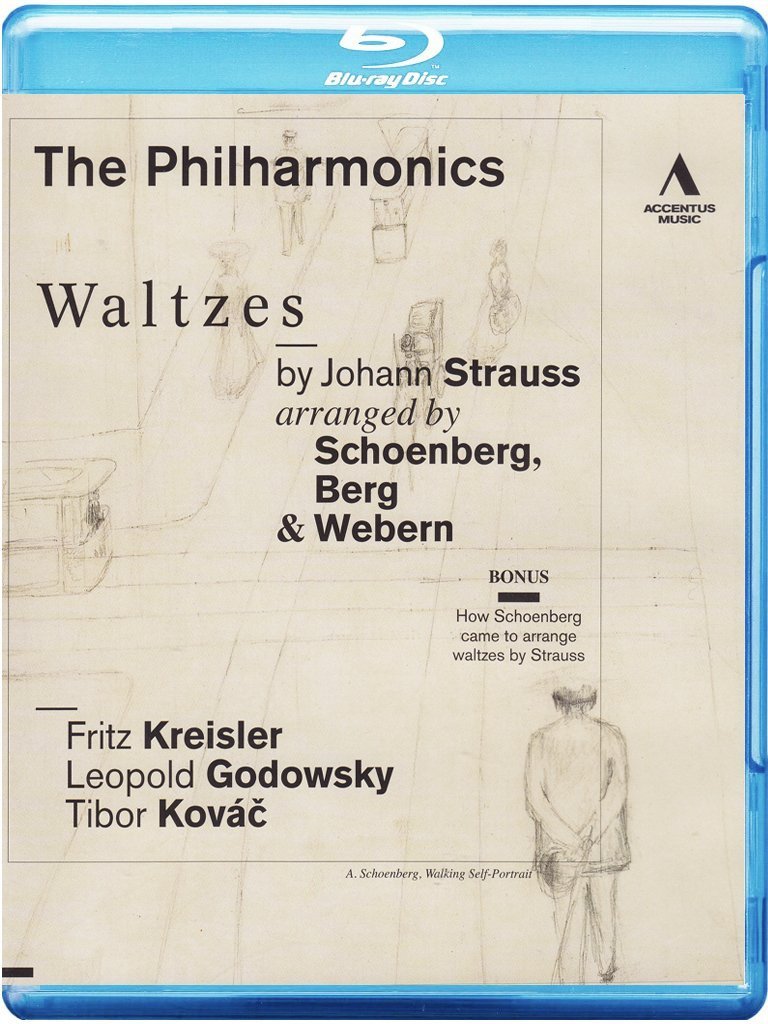
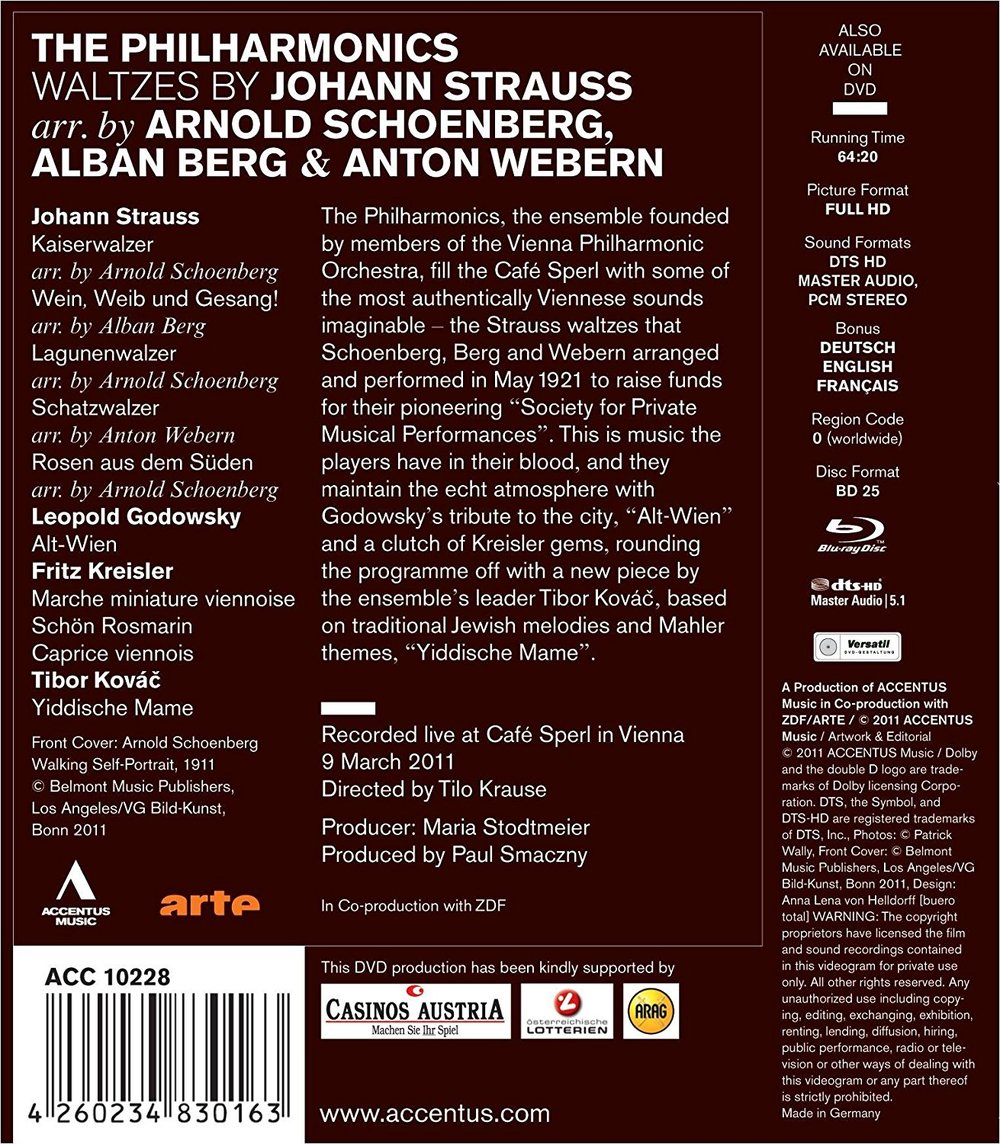
Waltzes (Vienna Café Music) by The Philharmonics, a group of star players from the Vienna Philharmonic Orchestra augmented from time to time by guests. These elites enjoy slumming around with fare ranging from Vienna favorites to Latin Jazz to Gypsy and other folk music. Of the 10 numbers presented on the disc, only 5 are Strauss waltzes. So I'm going to call this Waltzes (Vienna Café Music).
Members of the Philharmonics on this disc are Tibor Kováč (first violin), Shkëlzen Doli (second violin), Thilo Fechner (viola), Stephan Koncz (cello), Ödön Rácz (double bass), Daniel Ottensamer (clarinet), and František Jánoška (piano). Guest stars are Walter Auer (flute) and Christoph Traxler (harmonium).
Here are the selections on Waltzes (Vienna Café Music):
Johann Strauss II Kaiserwalzer
Fritz Kreisler Marche miniature viennoise
Johann Strauss II Schatzswalzer
Johann Strauss II Rosen aus dem Süden
Fritz Kreisler Schön Rosmarin
Fritz Kreisler Caprice viennois
Johann Strauss II Wein, Weib, and Gesang!
Tibor Kováč Yiddische Mame
Johann Strauss II Lagunenwalzer
Leopold Godowsky Alt-Wien
Directed for TV by Tilo Krause; photography directed by Nyika Jancsó; audio production by Joachim Müller; Maria Stodtmeier and Paul Smaczny were Executive Producers. Released 2011, disc has 5.1 dts-HD Master Audio sound. Grade: A
One of the great things about HDVDs is the availability of disc space for bonus information about the main recording. In the bonus for this title, we learn why Schönberg and his friends got involved with Strauss waltzes. Schöenberg was more than just a composer; he was a leader and advocate for what was then modern music:

He also was a painter and designer. Here's one of many self-portraits:

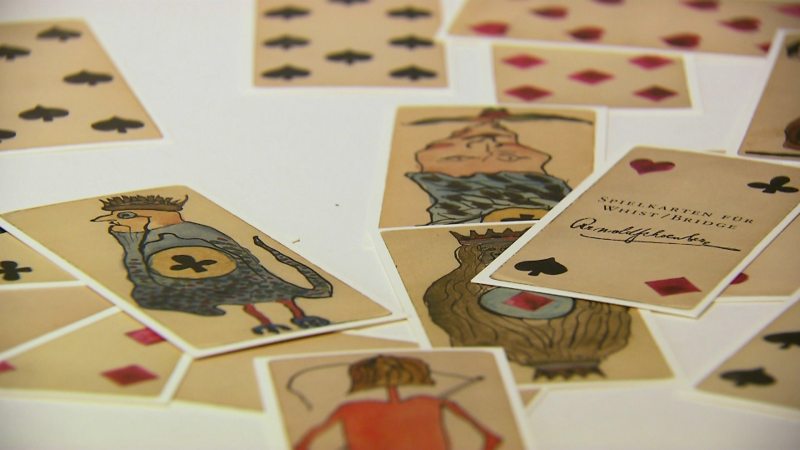
Here are playing cards he designed:
Schönberg's early concerts with modern music provoked disruption and near-riots. Schönberg formed a special society for presentation of modern music. The members had to pledge to refrain from clapping or booing. The program notes below read: "Monday, March 8, 1920. Second Concert of the Society for Private Musical Performances in Vienna led by Arnold Schönberg. The program: Scriabin Sonata No. 7 . . . ." Today we would call much of this program "late romantic"; but in 1920, it was too controversial for normal public presentation!

The new society lost money. So Schönberg promoted a benefit concert with the performance of new arrangements of 4 Strauss waltzes for chamber orchestra, followed by an auction of the scores. The program below reads, " Extraordinary Evening. Friday, May 27, 1921 at 7:00 p.m. at the Festival Hall of the Black Forest School. Four Johann Strauss waltzes arraigned for Chamber Orchestra." The arraignments were by Schönberg, Alban Berg, and Anton von Webern. Berg played the harmonium, Schönberg was second violin, and Webern played cello:

Flash forward: Now the four 1921 waltz arrangements are all played by the Philharmonics (along with 5 other Vienna classics) for us. This time the venue is the famous Café Sperl on Gumpendorfer Strasse in Vienna:

Schönberg, Berg, and Webern are still considered to be avant-garde musical deconstructionists for their work as founders of the Second Vienna School — fearsome junk-yard dogs out to scrap melody, harmony, and rhythm in Western music. So what would waltzes from them be like? Well, the most refreshing, delicious confections of melodious, harmonic, danceable café music that you could imagine. And the Philharmonics play these scintillating waltzes (and the rest of the program) in an unbelievably vivacious manner.
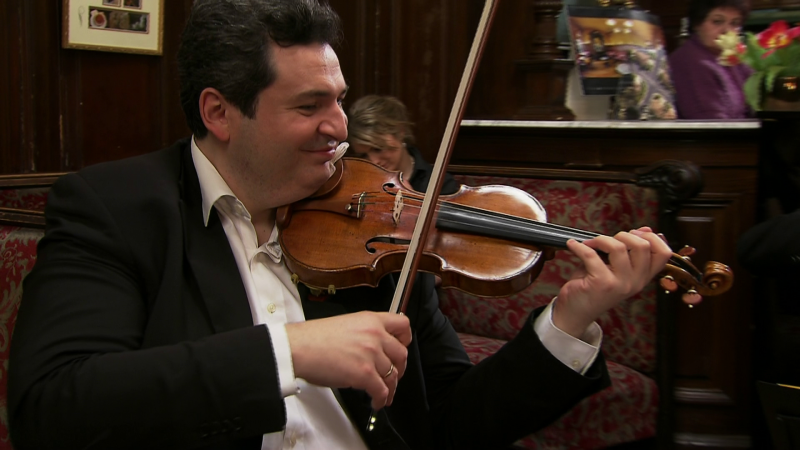
They all are having so much fun. Here first violin Tibor Kováč:
And second violin Shkëlzen Doli:

Here we see Ödön Rácz on double bass, Thilo Fechner on viola, and Stephan Koncz on cello. They are playing Schön Rosmarin. The first violin tosses out a series of clever, lilting melodies. With astonishing alacrity, Ödön on double bass throws the melodies right back several octaves lower, and the viola and cello guys love it:

Here's Christoph Traxler on harmonium:

And this is the core band of 6 players:

Stephan Koncz on cello and Daniel Ottensamer on clarinet:

My impression is that in the past a lot of waltz and similar music was heard in Vienna cafés performed by small groups. I have on my shelf a once-treasured CD of such music played by the Alexander Schneider Quintet and called The Beautiful Blue Danube. Now that I've seen and heard The Philharmonics, my poor CD sounds positively dreary. This Waltzes (Vienna Café Music) by The Philharmonics is the perfect demo disc for any home theater — it will get rid of the teenagers, but everybody else will adore it.

But I doubt that many café patrons have heard anything like The Philharmonics. This is a fairly large group of virtuosos. If The Philharmonics would really show up at the Sperl, nothing else would happen---the cooks would come out of the kitchen, tourists would swamp the place from the street, and the regulars would sit there with their mouths handing open. The performance is that strong. And we are lucky that both the video and audio recordings do justice to the material.

Andrew Lamb gave this title a nice write-up in the April 2012 Gramophone at page 60 calling it an "admirable demonstration how video can combine enlightenment and pleasure to joyous effect."
The only problem with the disc is the nagging thought that, as good as it is, is it still a bit of a missed opportunity? The total time for the music on this title is 62 minutes, which is enough for a music CD but not enough for an HDVD that can hold 4 hours + of music video. Isn't there a lot more other music that could have been included? And why such a dismal choice of cover art? Never has such a delightful book had such an ugly cover.
Now for a grade. This is a "A+" performance. But because the program is not all that generous and for the lack of 96kHz24bit recording, I knock the grade down to an "A."
OR
