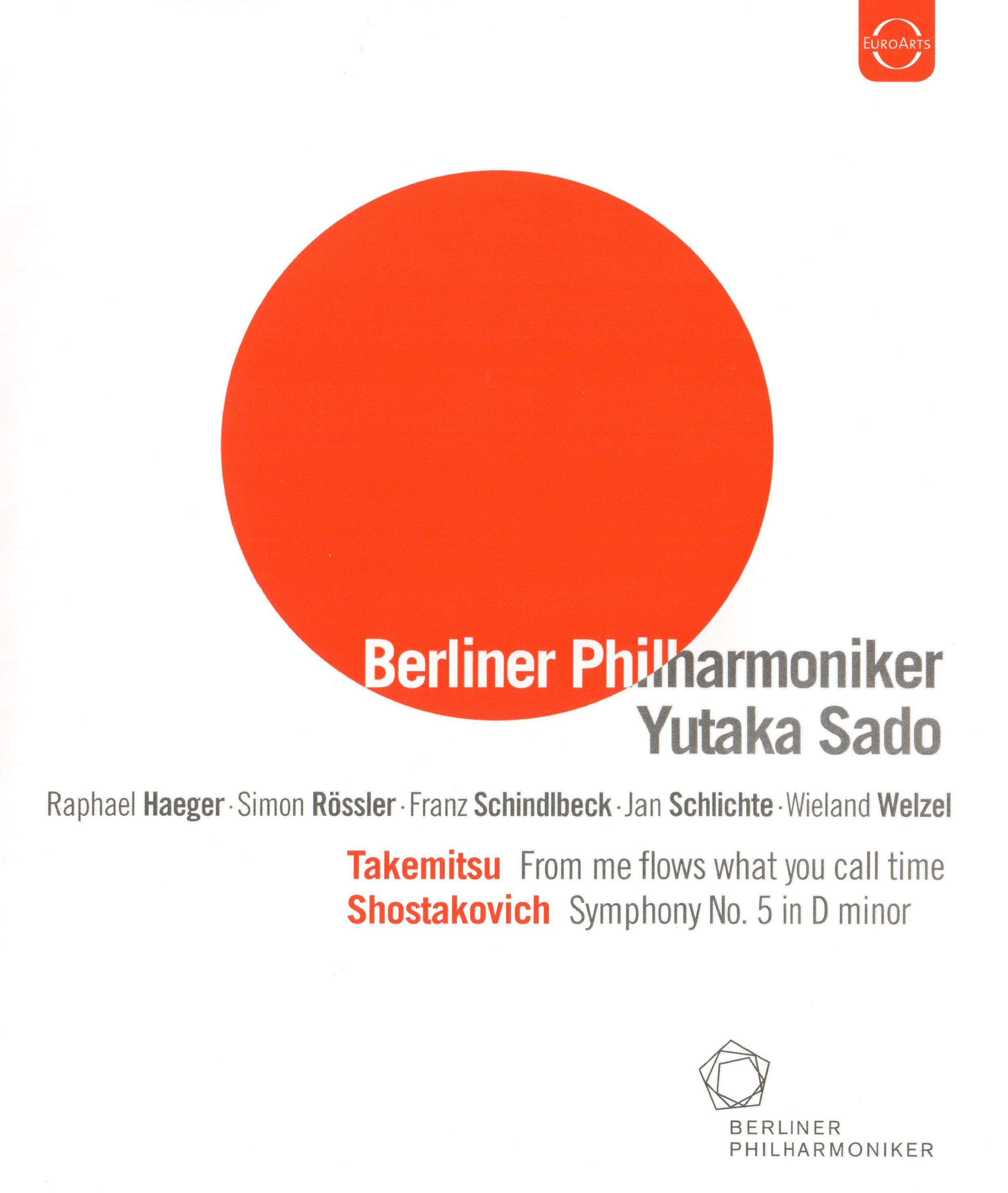
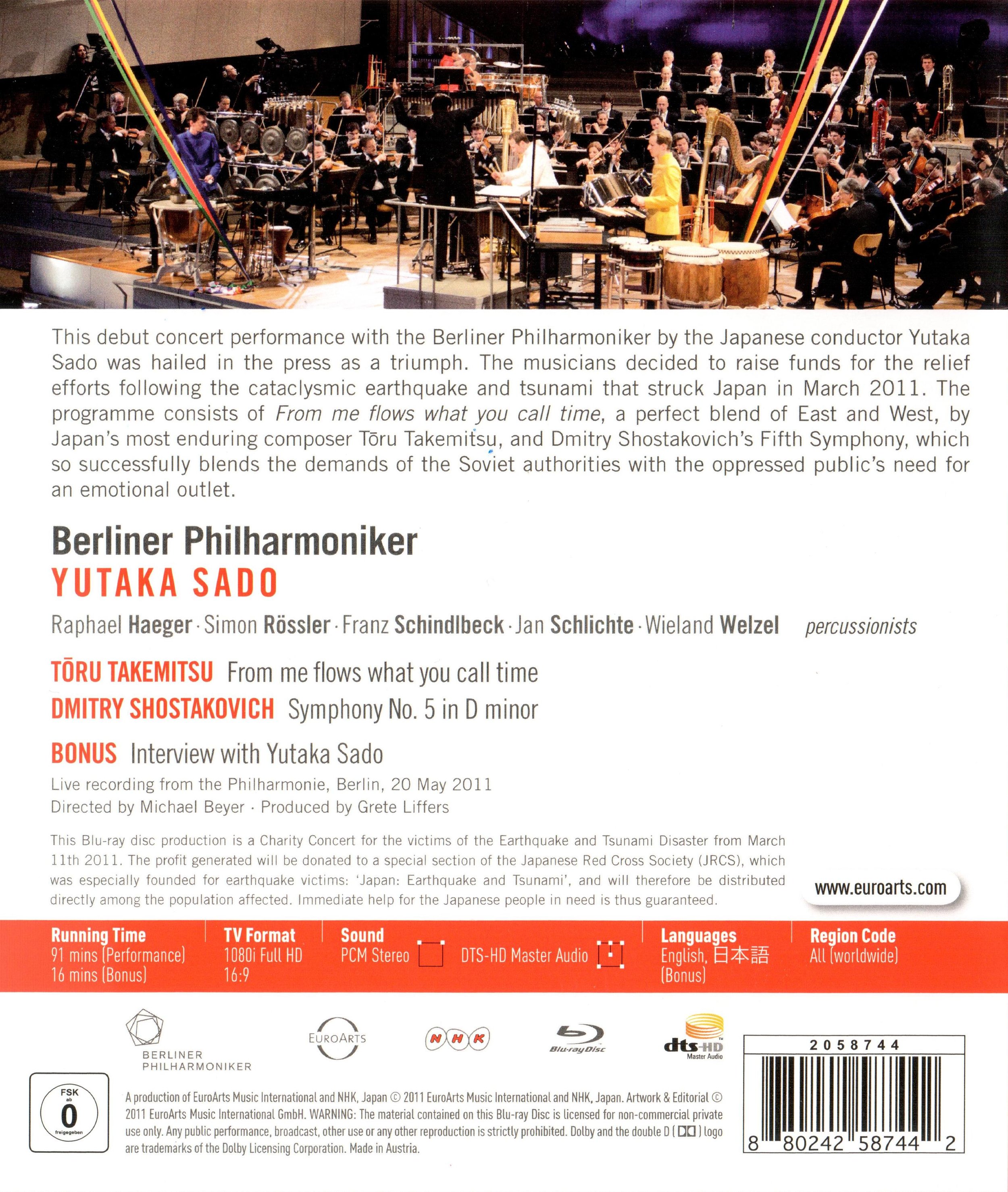
Takemitsu From me flows what you call time and Shostakovitch Symphony No. 5. Yutaka Sado conducts his debut with the Berliner Philharmoniker in 2011 at the Berlin Philharmonie. The Takemitsu piece features the entire percussion section of the Philharmoniker: Raphael Haeger, Simon Rössler, Franz Schindlbeck, and Jan Schlichte with Wieland Welzel (one of the timpani players). Directed for TV by Michael Beyer; produced by Grete Liffers. Released in 2011, disc has 5.1 dts-HD Master Audio sound. Grade: B+ for Takemitsu Grade: C+ for Shostakovich
This was a special performance to raise relief funds for the people of Japan following the earthquakes and tsunami of March 2011. So this was a special recording put together quickly for a topical reason. The HD resolution is a bit soft and the color a bit washed out. The sound is acceptable.
Not many Westerners are familiar with the music of Takemitsu. But readers of this website know about his My Way of Life staged concert spectacular, which was presented in Berlin by the Staatskapelle in 2004. Also, if you have seen many Japanese motions pictures, you may know more about Takemitsu than you realize because Takemitsu was Japan's leading composer of film scores and wrote the music for many of the most famous Japanese movies.
From me flows what you call time was scored for a large variety of Eastern percussion instruments backed up by a symphony orchestra. Some of the percussion instruments look pretty exotic; others look exactly like the wind chimes hanging from the eave of my back porch. The percussionists wear special colorful coats and there are other props that make this performance unique.
Different batteries of percussion instruments are located throughout the stage. This means the seating of the orchestra gets chopped up in an unusual way. Normally we look for video content in a symphony HDVD that features large scale shots of the orchestra and its major sections. But because the orchestra here is in the background and fragmented geographically on the stage, throw out the usual rules. Here the video consists mostly of close-ups of the 5 percussionists, a few orchestra soloists, and the conductor. Fortunately, Yutaka Sado is a fun conductor to watch.
The music is fascinating and easy to enjoy. Still, much of this would be lost in sound recording only; it's strikingly (pardon pun) beautiful on HDVD. Most classical music lovers would find this recording enjoyable; viewers with an interest in percussion music might consider this a "must have" recording. So I wind up with the grade of B+ for From me flows what you call time.
The Philharmoniker picked the Shostakavich Symphony No. 5 to finish out the program probably because it is a modern Western piece written in response to extremely daunting public events in the life of the composer. Yutaka Sado states in the bonus feature that he hears this piece differently (following the Japanese tsunami) in that it now "reminds me to pray." Sado also relates in the bonus that he first formed the ambition to conduct the Berlin Philharmoniker when he was 11 years old. This explains the tremendous emotion displayed by Sado as he conducts the Philharmoniker for the first time in his career.
Sado gets more emotion from his players than most other conductors with big dynamic changes along with wonderful soloist and section playing. Sado is a tall, strapping, cheerful man who leaps in the air (like an athlete blocking a shot) when he orders the percussionist to hit the bass drum as hard as he can. It could be dangerous to let this guy down, so the Berlin players respond with explosions of panache. During the final applause, the members of the orchestra first seem to be affected by a bit of shock and awe, but after a few moments, they start clapping for each other.
But, alas, this excellent performance is not matched by the PQ, SQ, or video content of the title. We already noted the soft picture and unremarkable sound. But the real problem is that this disc has a case of DVDitis. The cameras are constantly in motion moving from the conductor (including many shots made over the backs of the musicians) to soloists and small groups. Between cuts there is excessive panning and zooming. As mention earlier, the DVD approach is probably appropriate for the percussion extravaganza, but it sinks the Shostakavich symphony. With weaknesses in PQ, SQ, and video content, we would normally have to give a low grade; because of the enthusiasm of the performance, we arrive at C+.
Next below is a neat video from this performance: