Concert

Takemitsu From me flows what you call time and Shostakovitch Symphony No. 5


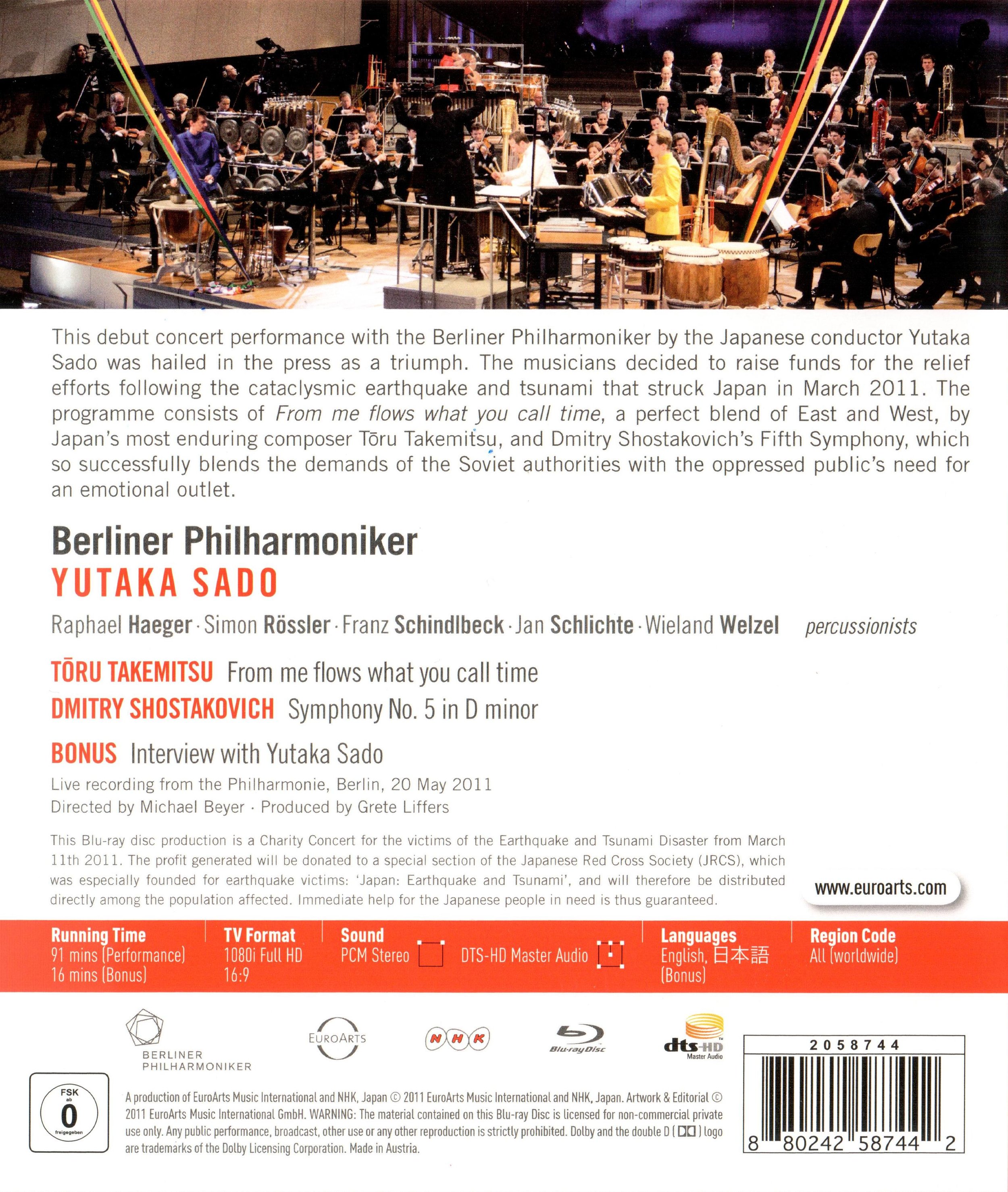
Takemitsu From me flows what you call time and Shostakovitch Symphony No. 5. Yutaka Sado conducts his debut with the Berliner Philharmoniker in 2011 at the Berlin Philharmonie.  The Takemitsu piece features the entire percussion section of the Philharmoniker:  Raphael Haeger, Simon Rössler, Franz Schindlbeck, and Jan Schlichte with Wieland Welzel (one of the timpani players). Directed for TV by Michael Beyer; produced by Grete Liffers. Released in 2011, disc has 5.1 dts-HD Master Audio sound. Grade: B+ for Takemitsu  Grade: C+ for Shostakovich

This was a special performance to raise relief funds for the people of Japan following the earthquakes and tsunami of March 2011. So this was a special recording put together quickly for a topical reason. The HD resolution is a bit soft and the color a bit washed out. The sound is acceptable.

Not many Westerners are familiar with the music of Takemitsu. But readers of this website know about his My Way of Life staged concert spectacular, which was presented in Berlin by the Staatskapelle in 2004. Also, if you have seen many Japanese motions pictures, you may know more about Takemitsu than you realize because Takemitsu was Japan's leading composer of film scores and wrote the music for many of the most famous Japanese movies.

From me flows what you call time was scored for a large variety of Eastern percussion instruments backed up by a symphony orchestra. Some of the percussion instruments look pretty exotic; others look exactly like the wind chimes hanging from the eave of my back porch. The percussionists  wear special colorful coats and there are other props that make this performance unique.

Different batteries of percussion instruments are located throughout the stage. This means the seating of the orchestra gets chopped up in an unusual way. Normally we look for video content in a symphony HDVD that features  large scale shots of the orchestra and its major sections. But because the orchestra here is in the background and fragmented geographically on the stage, throw out the usual rules. Here the video consists mostly of close-ups of the 5 percussionists, a few orchestra soloists, and the conductor. Fortunately, Yutaka Sado is a fun conductor to watch.

The music is fascinating and easy to enjoy. Still, much of this would be lost in sound recording only; it's strikingly (pardon pun) beautiful on HDVD. Most classical music lovers would find this recording enjoyable; viewers with an interest in percussion music might consider this a "must have" recording. So I wind up with the grade of B+ for From me flows what you call time.

The Philharmoniker picked the Shostakavich Symphony No. 5 to finish out the program probably because it is a modern Western piece written in response to extremely daunting public events in the life of the composer. Yutaka Sado states in the bonus feature that he hears this piece differently (following the Japanese tsunami) in that it now "reminds me to pray." Sado also relates in the bonus that he first formed the ambition to conduct the Berlin Philharmoniker when he was 11 years old. This explains the tremendous emotion displayed by Sado as he conducts the Philharmoniker for the first time in his career.

Sado gets more emotion from his players than most other conductors with big dynamic changes along with wonderful soloist and section playing. Sado is a tall, strapping, cheerful man who leaps in the air (like an athlete blocking a shot) when he orders the percussionist to hit the bass drum as hard as he can. It could be dangerous to let this guy down, so the Berlin players respond with explosions of panache. During the final applause, the members of the orchestra first seem to be affected by a bit of shock and awe, but after a few moments, they start clapping for each other.

But, alas, this excellent performance is not matched by the PQ, SQ, or video content of the title. We  already noted the soft picture and unremarkable sound. But the real problem is that this disc has a case of DVDitis. The cameras are constantly in motion moving from the conductor (including many shots made over the backs of the musicians) to soloists and small groups. Between cuts there is excessive panning and zooming. As mention earlier, the DVD approach is probably appropriate for the percussion extravaganza, but it sinks the Shostakavich symphony. With weaknesses in PQ, SQ, and video content, we would normally have to give a low grade; because of the enthusiasm of the performance, we arrive at C+.

Next below is a neat video from this performance:
Mahler Symphony No. 8 "Symphony of a Thousand"


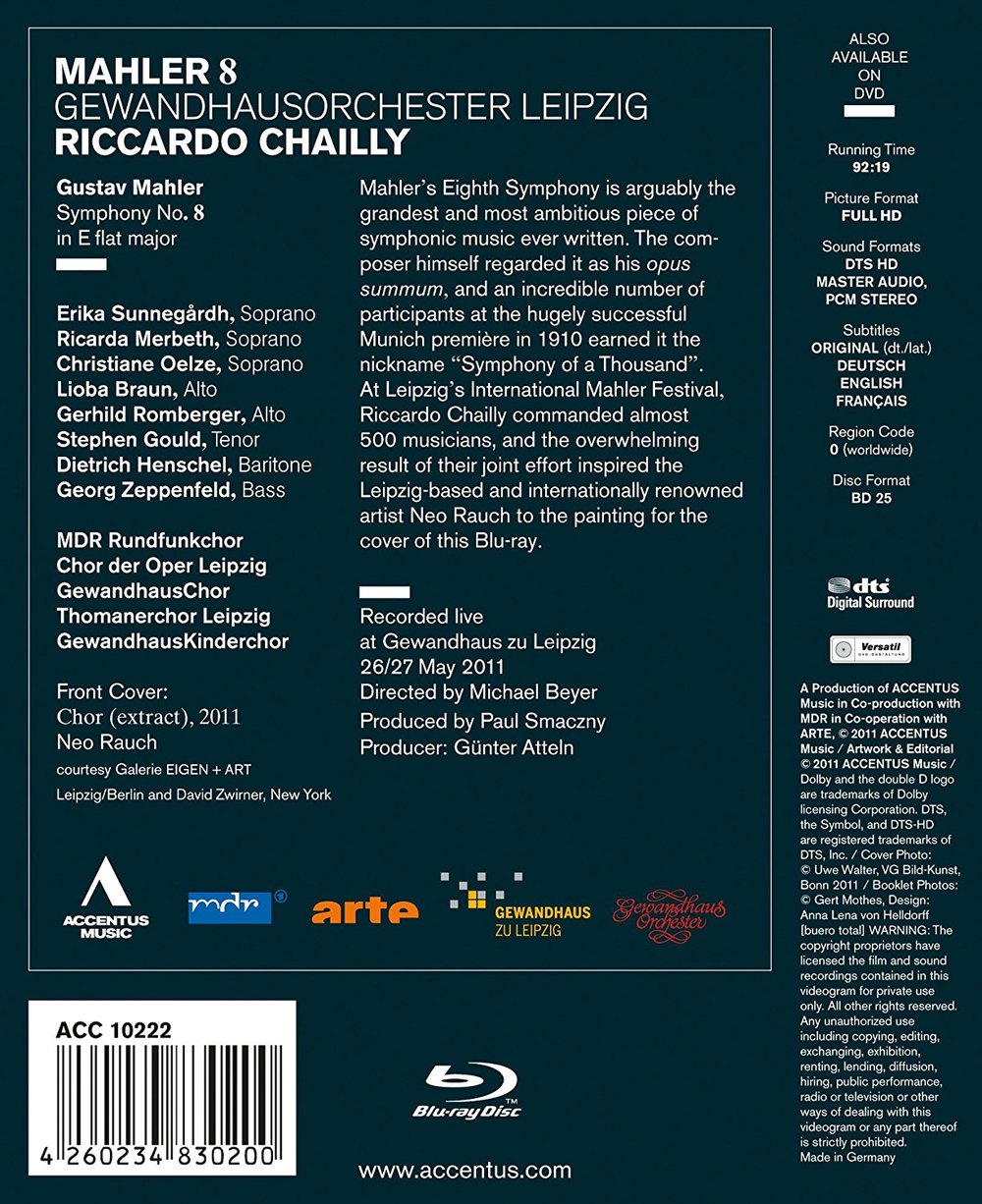
Mahler Symphony No. 8 ("Symphony of a Thousand"). Riccardo Chailly conducts 2011 the Gewandhausorchester Leipzig as well as the MDR Rundfunkchor, the Chor der Oper Leipzig, the GewandhausChor, the Thomanerchor Leipzig, and the GewandhausKinderchor (Chorus Masters Howard Arman, Georg Christoph Biller, Frank-Steffen Elster, Gregor Meyer, and Volkmar Olbrich). Soloists are Erika Sunnegårdh (soprano), Ricarda Merbeth (soprano), Christiane Oelze (soprano), Lioba Braun (alto), Gerhild Romberger (alto), Stephen Gould (tenor), Dietrich Henschel (baritone), and Georg Zeppenfeld (bass). Directed for TV by Michael Beyer; produced by Paul Smaczny. Released 2011, disc has 5.1 dts-HD Master Audio sound. Grade: NA

Here's an official clip saturated with DVDitis:

OR

Ravel Piano Concerto in G and Romeo and Juliet Suites 1 & 2

This is a concert given in 2009 at the Nobel Prize festivities. Yuri Temirkanov conducts The Royal Stockholm Orchestra. Martha Argerich is solo pianist. The following music is performed:

  •  Shostakovich Festive Overture

  •  Ravel Piano Concerto in G major (the one with 2 hands)

  •  Chopin Mazurka in C major

  •  Prokofiev Suite No. 2 from Romeo and Juliet (excerpts)

  •  Prokofiev Suite No. 1 from Romeo and Juliet (excerpts)

Produced by Paul Smaczny and Camilla Hyltén-Cavallius; directed for TV by Michael Beyer. Released 2011, disc has 5.1 dts-HD Master Audio sound. Grade: D


Read More

Beethoven: The Complete Symphonies

Beethoven: The Complete Symphonies. This is a Box Set of all 9 Beethoven symphonies played by the Wiener Philharmoniker as conducted by Christian Thielemann. There are also  documentaries for each symphony. These titles were released earlier as follows:

1. Beethoven Symphonies 1-3 (Grade: B-)

2. Beethoven Symphonies 4-6 (Grade: C)

3. Beethoven Symphonies 7-9 (Grade: B-)

All discs have 5.0 dts-HD Master Audio for the music, and 2.0 stereo sound for the documentaries. 


Read More

My Way of Life

Tōru Takemitsu My Way of Life staged concert spectacular or performance art work. Directed 2005 by Peter Mussbach at the Tokyo Bunka Kaikan Main Hall. Stars Dwayne Croft (Old Hag), Christine Oesterlein (Old Woman), Georgette Dee (Actress), Mélanie Fouché (Girl), Karen Rettinghaus (Girl), Kifu Mitsuhashi (Shakuhachi), Yukio Tanaka (Biwa), Yasunori Yamaguchi (Percussion), and Daisuke Suzuki (Guitar). Kent Nagano conducts the Deutsches Symphonie-Orchester Berlin and Tokyo Opera Singers. Set design by Erich Wonder; costumes by Eiko Ishioka; lighting by Alexander Koppelmann. We don't know who to credit for the filming of this.

This is a 2 disc set. Disc 1 is the HDVD recording of the performance. It has 5.1 PCM (48kHz/16 bit) and 5.1 Dolby Digital (48kHz/16 bit) surround sound. Disc 2 is a DVD with an extremely detailed and  valuable documentary about Takemitsu's life and the making of Disc 1.

This was published in 2010, primarily for the Japanese market. But the disc menus and the box booklet have enough English text for an English-speaking person to navigate and enjoy the production. Oddly, when the characters sing or speak in Japanese or French, there are English subtitles. But when they use English, it's assumed that the English speaking viewer can understand and the subtitles are in Japanese only. But understanding the English being sung in such a strange setting as this is quite difficult and frustrating. If the viewer commands neither Japanese nor English, this production will most likely remain a closed book. Grade: B+


Read More

Seiji Ozawa 75th Anniversary Box Set

Seiji Ozawa 75th Anniversary Box Set. This set has 5 Blu-ray jewel boxes:

1. Brahms Symphony No. 2 & Shostakovich Symphony No. 5. This is a superb HDVD that you can buy separately. We graded both titles A+ elsewhere on this site.

2. Janáček Cunning Little Vixen. This is a nice HDVD that you can buy separately. We graded it B+ elsewhere on this site.

3. The Last Don Quixote. Mstislav Rostropovich and Seiji Ozawa playing Strauss's Don Quixote. This is a complicated two disc set. Disc 2 is the main show---a performance (43 minutes) of Don Quixote from 2002 with the Saito Kinen Orchestra. This performance has decent video and was recorded with 5.0 PCM 96 kHz/24 bit surround sound. Disc 1 is a strange mixed bag. It has a 1 hour, 15 minute documentary, with good video and 5.0 PCM 96 kHz/24 bit surround sound, about the Don Quixote recording. The documentary includes rehearsal video with a lot of personal information about Rostropovich. The documentary also has a fanciful Don Quixote movie (43 minutes) that illustrates the Cervantes story as told by Strauss in the tone poem. Then follows a 1995 concert with Rostropovich and the NHK Orchestra playing the Dvořák Concerto for Cello. This performance has remarkable good video but there is only stereo sound (which is quite good).

4. Beethoven Symphony No. 7/Mahler Symphony No. 9. This disc has material shot in 1989 & 2002 and does not meet our standards for an HDVD.

5. Extras Disc. This disc doesn't have an NSBS catalog number like the other disc packages because its just extras, including two short tutorials about western music from Ozawa & trailers for NHK HDVDs. This is all in Japanese with no subtitles. Some material is in SD & stereo. The value of this part of the set is nil for Japanese speakers and 0 for westerners.

So we can sum up the boxed set as follows: it has two fine titles (1 & 2 above) you can buy separately and an odd title (3 above) with a lot of material about the  Strauss Don Quixote plus a recording of the Dvořák Concerto for Cello. Then there are two jewel boxes (4 & 5 above) you can throw away. 

Read More

Martha Argerich & Mischa Maisky

Martha Argerich & Mischa Maisky concert. Argerich, Maisky, and the Lucerne Symphony perform:

  •  Dvořák Scherzo capriccioso in D flat major

  • Shchedrin Romantic Offering (world premiere)

  •  Franck Sonata for Cello and Piano in A Major

  •  Shostakovich Symphony No. 9

Neeme Jarvi conducts the Luzerner Sinfonieorchester. Directed for TV by Michael Beyer. Released 2011, disc has 5.1 dts-HD Master Audio sound. Grade: B+


Read More

Mahler Symphonies No. 1-7

Mahler Symphonies No. 1-7. Claudio Abbado conducts the Lucerne Festival Orchestra. Released 2011, this is a box set of seven discs from EuroArts, Mahler Symphonies No. 1, 2, 3, 4, 5, 6, and 7.  All of these titles have been previously released and reported on this website. See individual title stories for details.

Read More

Mahler Symphony No. 2 "Resurrection"

Mahler Symphony No. 2 "Resurrection". Claudio Abbado in 2003 conducts the Lucerne Festival Orchestra & the Orfeón Donostiarra (Chorus Master José Antonio Sainz Alfaro). Soloists are soprano Eteri Gvazava and contralto Anna Larsson. Directed for TV by Michael Beyer. Released 2010, EuroArts claimed that the disc has 5.1 dts-HD Master Audio surround sound, but see comments below. Grade: D


Read More

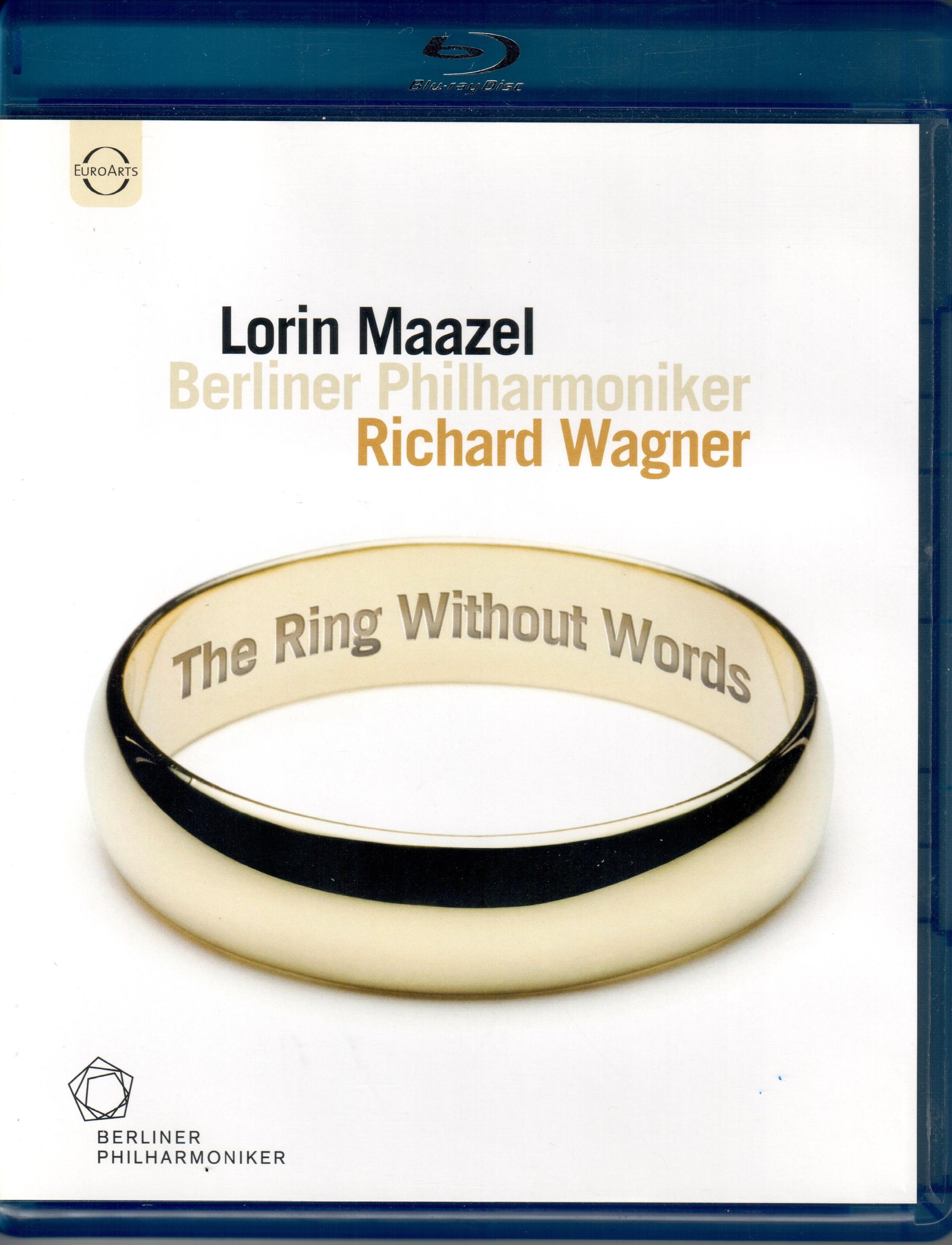
The Ring Without Words


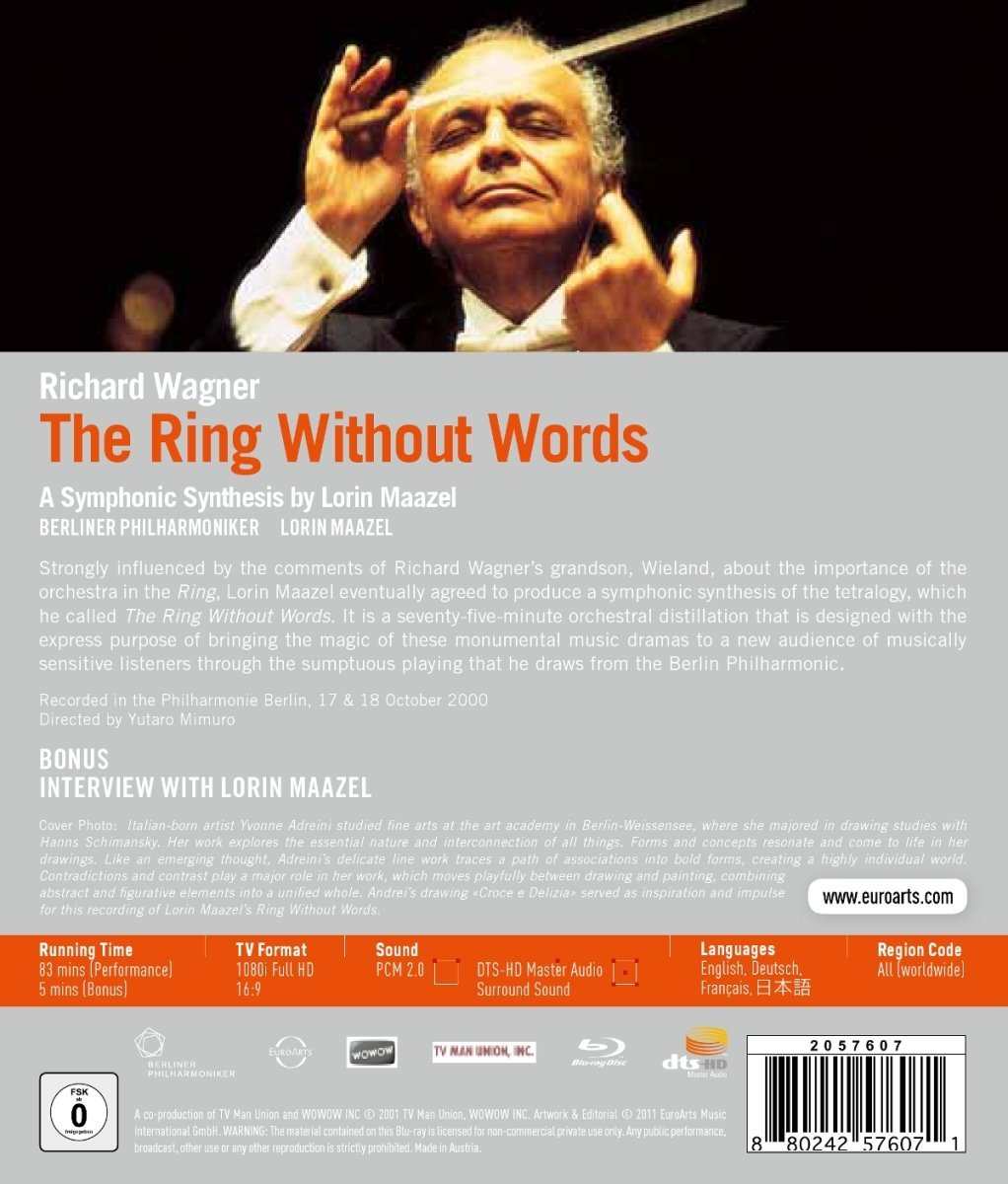
Wagner The Ring Without Words is an 83-minute long "symphonic synthesis" of selections from the orchestral music in the Ring cycle. This was arranged by Lorin Maazel, and Maazel recorded it with Berlin Philharmoniker. Released in 2012, disc has 5.1 dts-HD Master Audio sound. Grade: C

Lorin Maazel is one of the most experienced conductors in the world and also a composer. In 2000, Maazel was commissioned by Telarc to "edit" all of the Ring operas into a single orchestral piece that would provide a summary of the whole cycle in concert form for a symphony orchestra. This Maazel did by starting with the first note of Rheingold and ending with the last chord of Götterdämmerung. Along the way he added no music of his own. His contribution was to decide what to cut and where to "splice" the remaining music in a manner that would not sound jarring. Of course, no singing or staging was contemplated.

The idea was to present Wagner's core creation in a unified way (rather than just play a bunch of concert excerpts). This might be considered something of a gimmick. But the project apparently was successful. In 2000, Maazel recorded it with the Berlin Philharmoniker, and Telarc published this as a CD. According to Maazel (speaking in a bonus on subject disc) Telarc sold hundreds of thousands of CDs to folks who were a new audience for the Wagner Ring.  Maazel’s synthesis was taken up by other orchestras like  the Houston Symphony, which presented it in 2010.

Now guess what? Way back in 2000, Maazel and the Berlin Philharmoniker also made a video of The Ring Without Words. EuroArts got the rights to the video and published it in Blu-ray. From the artistic viewpoint, there can be no doubt that there is a market for the Ring without Words and that it can benefit many people as a video. Personally it reminds me of my passion for butter pecan ice cream. I just love butter pecan, but I don't want to eat a gallon of it in one hour. Ring without Words has most of the famous music and themes Wagner created in 4 long operas. The smashing together of so many dramatic musical ideas is efficient; but for me, it becomes tiresome.

Now lets turn our attention to the technical merits of the video. From the viewpoint of someone who has only experience with CDs, this video might be impressive. But from our perspective, the video is sadly obsolete.  The video was probably state-of-the-art in 2000. But the picture today has an over-illuminated and faded look with unsaturated colors and a generally listless aura. The title has Master Audio output, but that's no help if, as here, the master recording is muddy and lacking in fidelity. And, oh, the players in the orchestra in 2000 looks so much younger then than they look now!

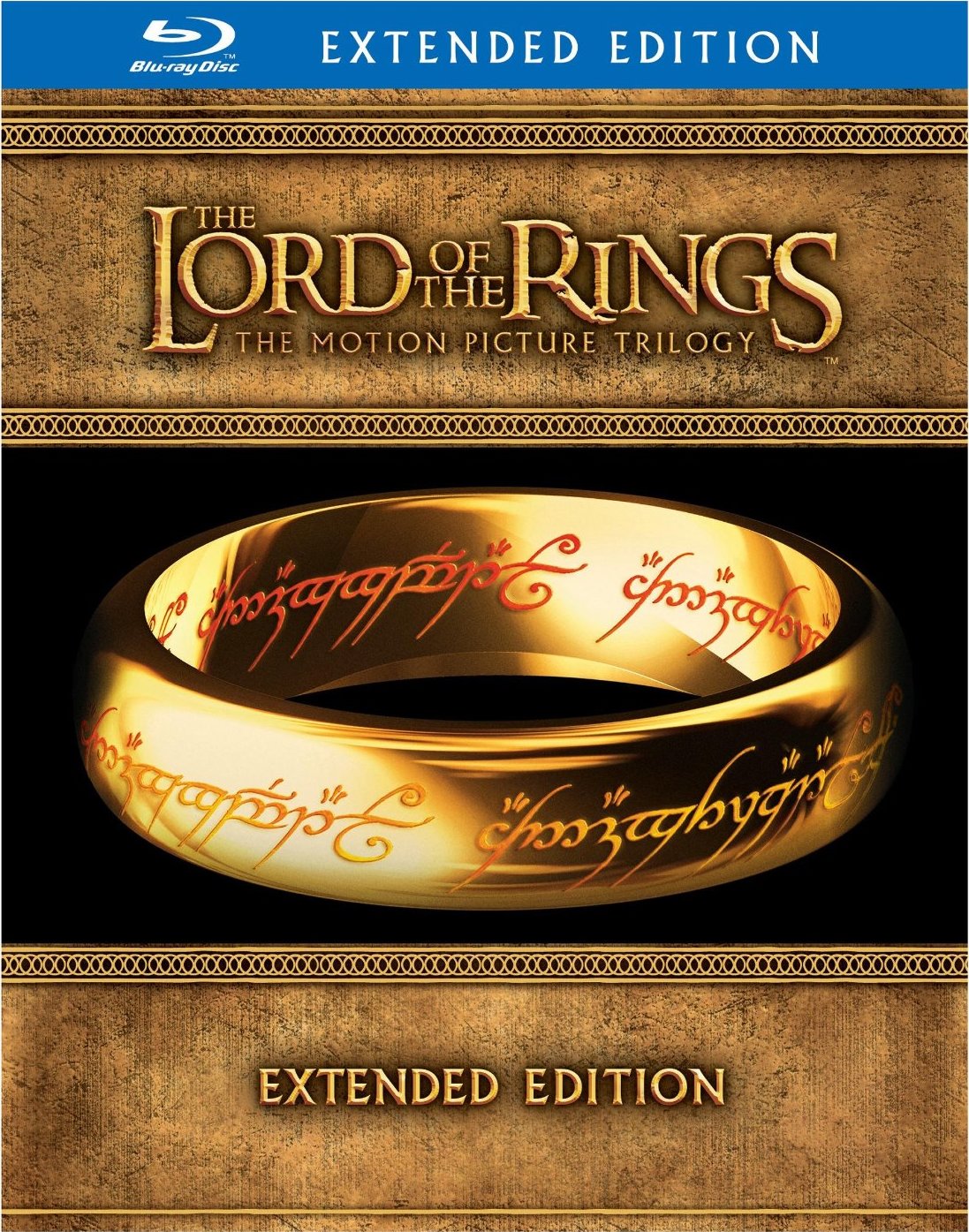
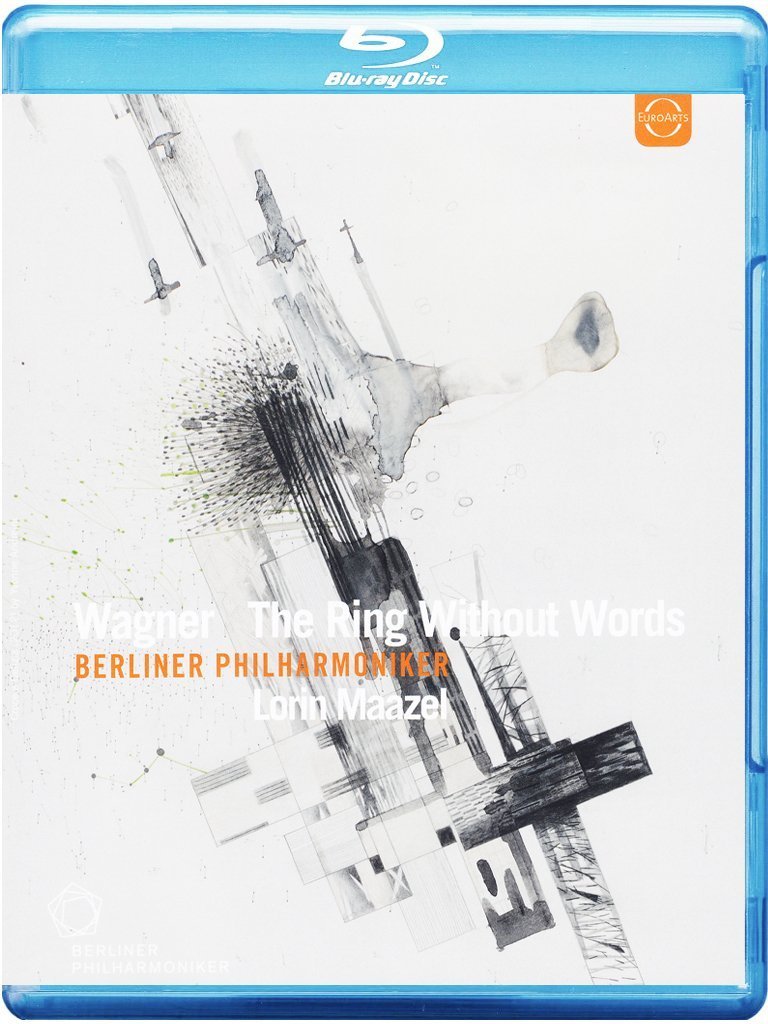
There has been confusion about the art work on the keepcase. The 1st of the 4 images in the slideshow above shows the original front cover. The 2nd image presents a problem. Who do you think has more lawyers: EuroArts or The Lord of the Rings? The 3rd image is the replacement cover art that's on the title now. The last image is the back-cover art, which is very similar to the original back art.

In summary, I don't think this year 2000 version of The Ring without Words will have much appeal to discerning HDVD fans. But a re-recording of the work per state-of-the-art of today might be a welcome addition to the catalog, that least for those who really love butter pecan.

OR

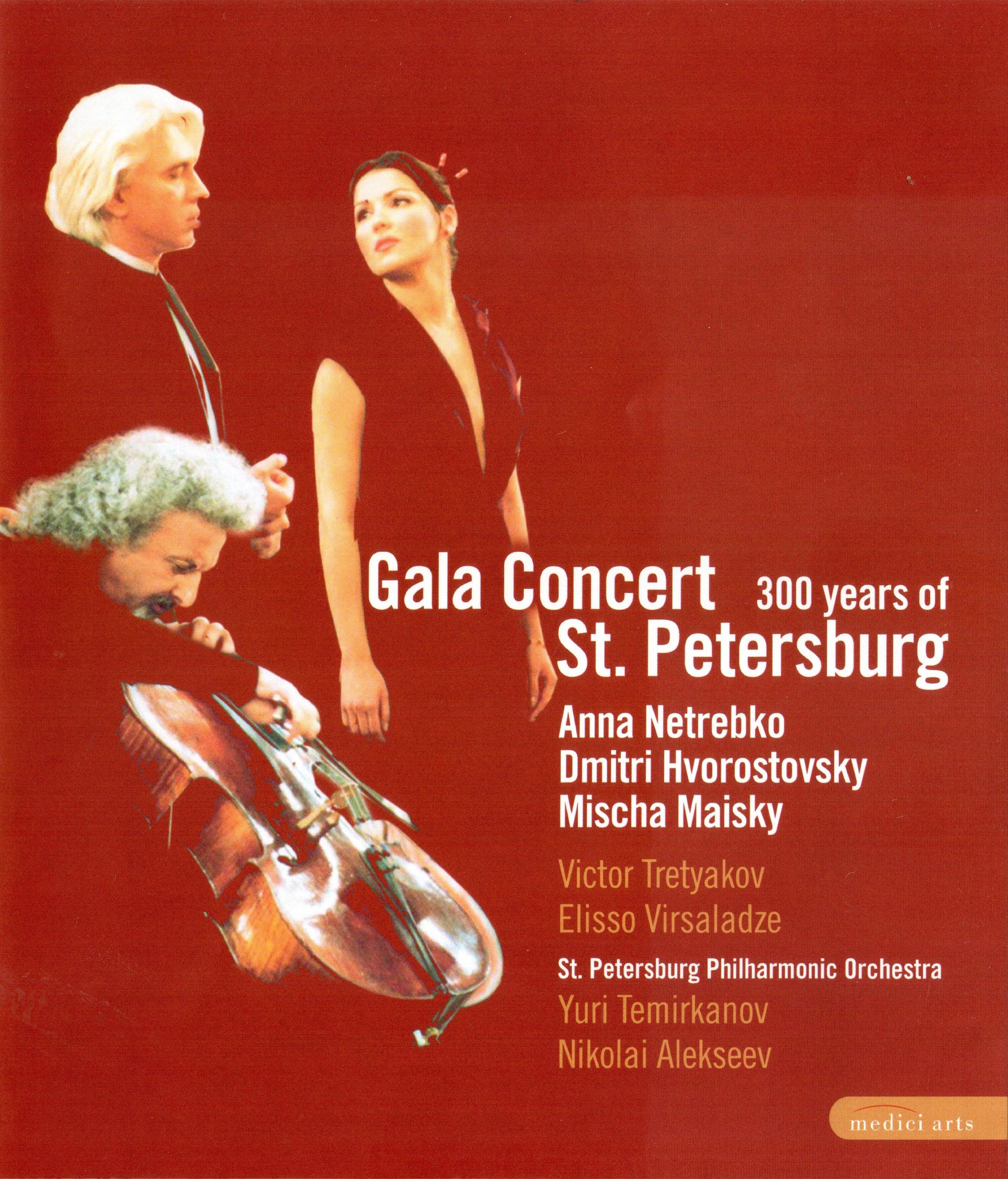
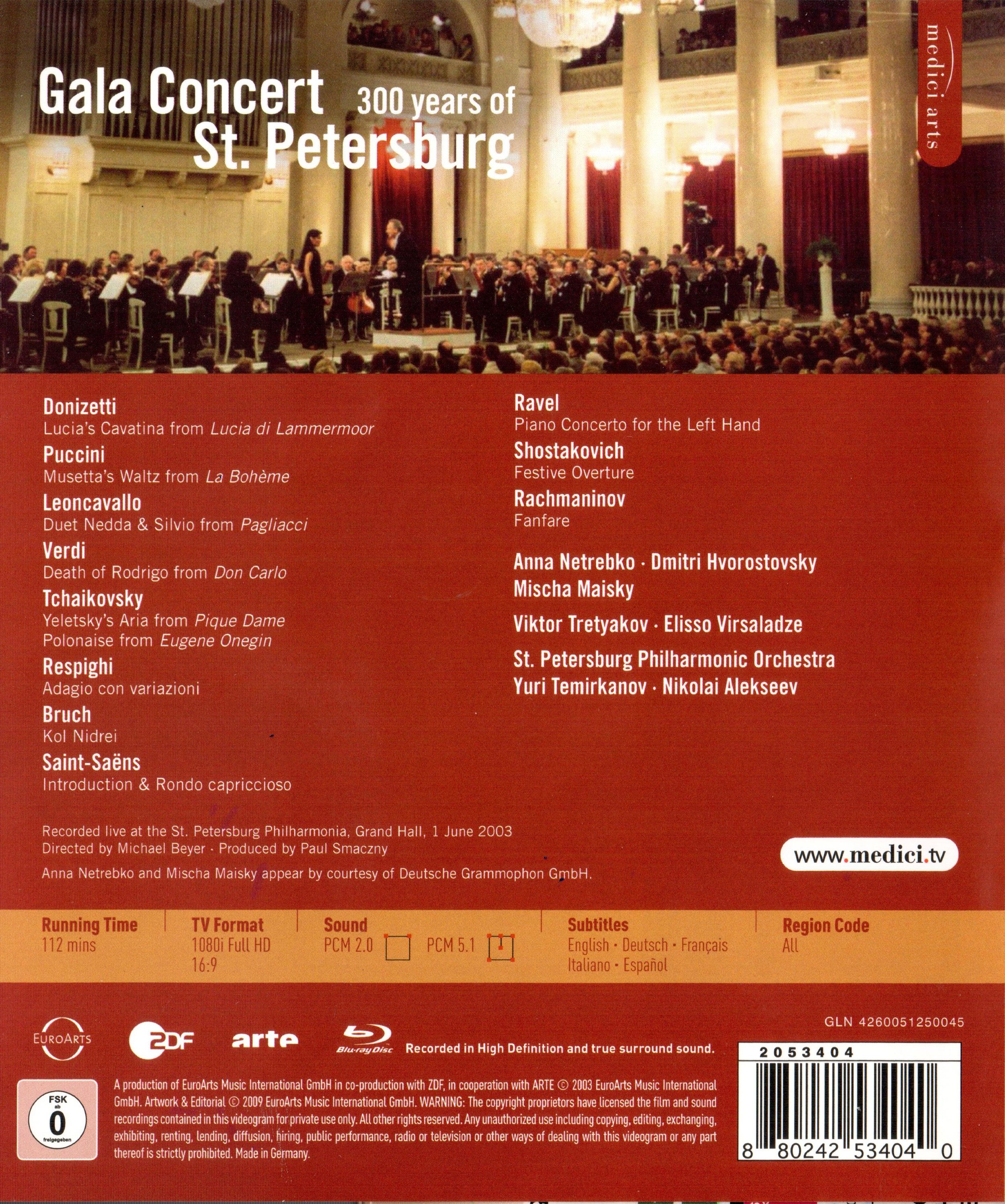
Gala Concert—300 Years of St. Petersburg


Gala Concert—300 Years of St. Petersburg. Stars Anna Netrebko (soprano), Dimitri Hvorostovsky (baritone), Mischa Maisky (cello), Elisso Virsaladze (piano), and Viktor Tretyakov (violin). Yuri Temirkanov and Nikolai Alekseev direct the St. Petersburg Philharmonic Orchestra. Works performed are:

  • Shostakovich: Festive Overture

  • Saint-Saëns: Introduction & Rondo capriccioso

  • Ravel: Concerto for the Left Hand for Piano and Orchestra

  • Tschaikovsky: "Polonaise" from Eugene Onegin

  • Donizetti: "Regnava nel silenzio" from Lucia di Lammermoor

  • Puccini: "Quando men vo" from La Bohème

  • Tschaikovsky: "Vy tak pechalny . . .Ya vas lyublyu" from Pique Dame

  • Verdi: "O Carlo, ascolta" from Don Carlo

  • Respighi: "Adagio con variazioni"

  • Bruch: "Kol Nidrei"

  • Leoncavallo: "Nedda!" - "Silvio! A quest' ora" from Pagliacci

  • Rachmaninov: "Fanfare"

Directed for TV by Michael Beyer. Released 2009, disc has 5.1 PCM sound. Grade: C

Although this concert (previously issued as a DVD) was shot in HD in a brightly illuminated hall, the picture seems soft and slightly washed out or hazy. At one point some SD material got into the mix. The sound quality seems to be a throwback to DVD days. For example, at the beginning of the Ravel Concerto for the Left Hand, there is a video shot of the basses playing softly. But on my system, I don't hear the big violins at all. Later, there are close-ups of the snare drum in action, but the drum sounds like it is being played outside the building.

The front art on the jewel box is pitifully amateurish. I'm no expert on printing, but I think the front cover art was supposed to be printed with the 3 color system using cyan, magenta, yellow, (and black).  I think the front cover has the magenta for sure but is missing the black (and maybe other information).  The splash screen on the disc is also crude.

A mediocre engineering job could be overlooked if the music on the disc were great. But, alas, I couldn't get excited about the content either. This was not a gala entertaining art patrons (where champagne music is all you want). This event (there were at least two performances) was to honor the people of St. Petersburg, and the people of St. Petersburg were there. These are people who in our times have suffered two world wars, a siege that cost a million lives, the greatest political terror in history, and a lost century. And what did the citizens of the Hero City—this city of sacrifice—get to assuage their pain? A festive overture, a fanfare, a one-hand piano concerto, Musetta's Waltz, and a duet from The Clowns. Those were the worst offenders. Anna Netrebko was still thin and unbelievable pretty in 2003. But she was dressed for the wrong kind of gala with a cocktail gown cut to the waist. Maybe this is what was bothering her as she struggled through her assignment.

Finally, Dmitri Hvorostovsky, strong and serene, stepped in to briefly turn the tide. His Yeletsky's aria (Pique Dame) and Death of Rodrigo (Don Carlo) were to me the only numbers on the program worthy of the people in attendance. Mischa Maisky came in first runner up with his heartfelt, warm cello renditions, but the effect was blunted for me by the gaudy jewelry he insists on wearing. This record was well-received in its DVD version. But in HDVD you can see and hear what's really going on: this event was a missed opportunity.

OR

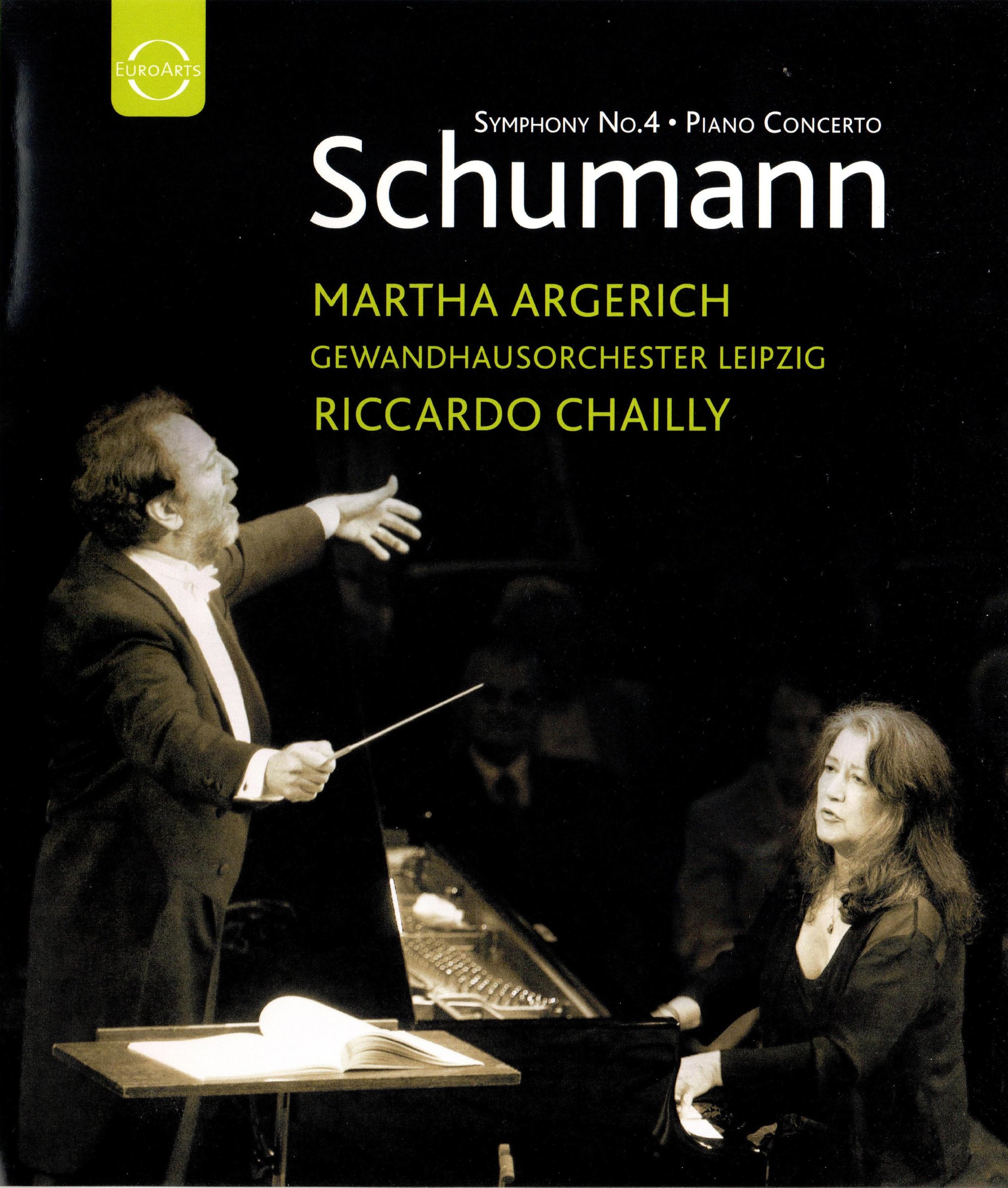
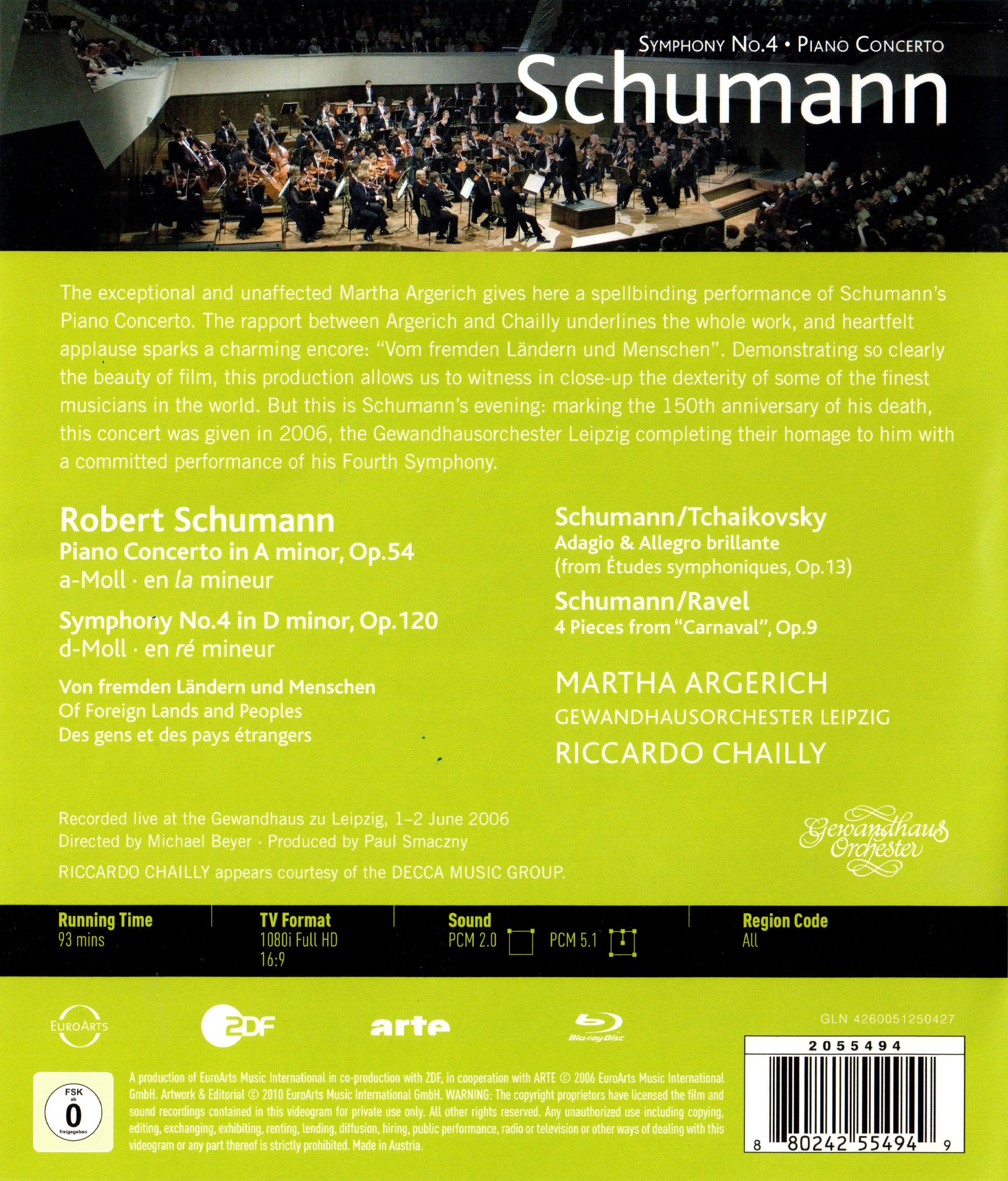
Schumann Piano Concerto & Schumann Symphony No. 4


Schumann Piano Concerto and Symphony No. 4 concert. In 2006 Riccardo Chailly conducts the Gewandhausorchester Leipzig with Martha Argerich as piano soloist. In addition, disc has 6 short pieces by Schumann:

  • "Adagio & Allegro brillante" arranged by Tchaikovsky, from Études symphoniques

  • "Von fremden Ländern und Menschen" from Kinderszenen (Argerich)

  • "Préambule" from Carnaval

  • "Valse allemande" from Carnaval

  • "Intermezzo: Paganini" from Carnaval

  • "Marche des Davidsbündler contre les Philistins" from Carnaval

Directed for TV by Michael Beyer. Released in 2010, disc has 5.1 PCM sound. Grade: NA

Chailly, gleefuly enthusiastic and expressive with his rubber face, could probably conduct with his hands tied behind him. Under his leadership, the Gewandhausorchester in 2010 was rated 17th in the world by Gramophone magazine. This is a very nice all-Schumann disc. It would be hard to imagine a better performance of the 4th Symphony than the one presented here. Chailly has a special relationship with Argerich, the chain-smoking kaffeine-krazy keyboard kamikaze of my youth who is now a plump Granny wearing an Hawaiian shirt skirt. Her performance was a little eccentric compared to my old Radu Lupu LP recording of the concerto. But she still has the knack for making the piano croon. This was especially noticeable when I compared her version of the concerto with the patrician-level rendition of this from Murray Perahia and the Royal Concertgebouw, also available in HDVD. When I hear Perahia play the concerto, I think of viewing old-master paintings in a beautiful museum in the capital of a nation. When I hear Argerich, I think of hiding in the shadows next to a moonlit meadow and stealing kisses before curfew. Which would you rather be doing right now?

Ives Holidays Symphony

Charles Ives Holidays Symphony. Michael Tilson Thomas directs the San Francisco Symphony in a recent performance of the Holidays Symphony as part of its "Keeping Score" outreach program. In addition, Thomas narrates an educational program about Ives and the Holidays Symphony. Directed for TV by Gary Halvorson. Released 2009, disc has 7.1 Dolby TrueHD sound. Grade: NA

Read More