Concert

San Francisco Symphony at 100

San Francisco Symphony at 100 concert. Michael Tilson Thomas conducts the San Francisco Symphony in a gala concert in honor of the San Francisco Symphony's first centenary.  The concert portion of program has 75 minutes of music as follows:

  •  Aaron Copland - Billy the Kid Ballet Suite

  •  Felix Mendelssohn - Violin Concerto in E minor (Itzhak Perlman)

  •  Benjamin Britten - The Young Person's Guide to the Orchestra

  •  John Adams - Short Ride in a Fast Machine

Also included is a 58-minute documentary narrated by Amy Tan about the history of the San Francisco Symphony. Directed for TV by Gary Halvorson; audio direction by Jack Vad. This disc is self-published by the San Francisco Symphony on the SFSmedia label. It has an "ALL" region logo on the back of the keep case.


Read More

St. Matthew Passion

Bach St. Matthew Passion oratorio. Ritualised (directed) 2010 by Peter Sellers at the Philharmonie in Berlin. Stars tenor Mark Padmore (Evangelist or John the Baptist), bass Christian Gerhaher (Jesus), soprano Camilla Tilling, contralto Magdalena Kozena, tenor Topi Lehtipuu, and bass Thomas Quasthoff (recitatives and arias), Jörg Schneider (Judas), Sören von Billerbeck (Peter), Axel Scheidig (Pontius Pilate), Christine Lichtenberg (1st Witness), Holgar Marks (2nd Witness), David Stingl (1st High Priest), Thomas Pfützner (2nd High Priest), Isabelle Voßkühler (1st Maiden), Christina Bischoff )(2nd Maiden), and Barbara Kind (Wife of Pontius Pilate).  Sir Simon Rattle conducts the Berliner Philharmoniker, the Rundfunkchor Berlin (Chorus Master Simon Halsey), and the Knaben des Staats und Domchors Berlin (Chorus Master Kai-Kwe Jirka). Music has runtime of 195 minutes and there is a 51-minute bonus extra with Peter Sellers in conversation with Simon Halsey.  Directed for TV by Daniel Finkerhagel and Alexander Lück.  Released 2012, disc has 5.1 dts-HD Master Audio sound. Luxury package also has 2 DVDs and other extra features.   Grade: NA


Read More

Salzburg Festival Opening Concert 2011

The 2011 Opening Concert for the Salzburg Festival consists of:

  • Berg Der Wein

  • Berg Lulu Suite

  • Mahler Das Klagende Lied

Pierre Boulez conducts the Vienna Philharmonic Orchestra and the Concert Chorus  of the Vienna State Opera (Chorus Master Jörn H. Andresen). Soloists are Dorothea Röschmann (soprano), Anna Prohaska (soprano), Anna Larsson (contralto), and Johan Botha (tenor). Directed for TV by Michael Beyer. Released 2012, disc has 5.1 dts-HD Master Audio sound. Grade: NA


Read More

Bach Mass in B minor and Beethoven Symphony No. 5

Bach Mass in B minor and Beethoven Symphony No. 5 concert. This title has two segments:

Segment 1 was recorded in 2005:

Bach Mass in B minor. Herbert Blomstedt conducts the Gewandhausorchester Leipzig and the GewandhausKammerchor Leipzig (Chorus Master Morten Schuld-Jensen) at the 2005 Leipzig Bach Festival. Soloists are Ruth Ziesak (soprano), Anna Larsson (contralto), Christoph Genz (tenor), and Dietrich Henschel (bass). Includes a bonus film Bach and his B minor Mass with Herbert Blomstedt. This segment was directed for TV by Michael Beyer and produced by Paul Smaczny.

Segment 2 was recorded in 1999 in Leipzig:

1. Bach Toccata & Fugue in D minor (Jürgen Wolf organ)

2. Bach Motet "Fürchte dich nicht" (Thomaner Chor with Chorus Master George Christoph Biller)

3. Bach Partita for solo violin No. 2 in D minor "Chaconne" (Victoria Mullova violin)

4. Mendelssohn Elias Op. 70 "Höre Israel" (Gewandhausorchester and Nancy Argenta soprano)

5. Mendelssohn "Fürchte dich nicht" from Elias (Gewandhausorchester and GewandhausKammerchor)

6. Beethoven Symphony No. 5. (Gewandhausorchester)

7. Bach Mass in B Minor "Dona Nobis Pacem" (Gewandhausorchester, GewandhausKammerchor, and Thomaner Chor)

Segment 2 was directed for TV by Bob Coles and produced by Paul Smaczny with Isabel Iturriagagoilita. Released 2012, has 5.1 dts-HD Master Audio sound. Grade: NA


Read More

Brahms Symphony No. 1, Dvořák Symphony No. 9, Sibelius Symphony No. 5, Nielsen Symphony No. 3

Here's the program:

  • Brahms Symphony No. 1

  • Dvořák Symphony No. 9 "New World"

  • Sibelius Symphony No. 5

  • Nielsen Symphony No. 3 "Sinfonia Espansiva"

Thomas Dausgaard conducts the Danish National Symphony Orchestra at the Koncerthuset in Copenhagen. Also features interviews with Dausgaard. Head of TV Project was Søren Therkelsen; Video Directors were Arne J. Rasmussen and Uffe Borgtardt; Sound Producer was Preben Iwan; Sound Engineer was Jan Oldrup.  Released 2012, disc has 5.1 dts-HD Master Audio sound. Grade: NA


Read More

Chopin Piano Concertos 1 & 2

Chopin Piano Concertos 1 & 2 concert played by Daniel Barenboim at the 2010 Ruhr Piano Festival with the Staatskapelle Berlin conducted by Andris Nelsons. Barenboim plays the Chopin Valse brillante in A Minor as encore. Also includes a performance of the Haydn Symphony in E minor ("Mourning") by the Staatskapelle Berlin and Nelsons.  Directed for TV by Enrique Sánchez Lansch; director of photography was Nyika Jancsó; produced by Paul Smaczny. Released 2011, disc has 5.1 dts-HD Master Audio sound. Grade: D+


Read More

Beethoven Piano Concerto No. 5 and Scheherazade

Beethoven Piano Concerto No. 5 and Rimsky-Korsakov Scheherazade. Andris Nelsons conducts the Royal Concertgebouw Orchestra at the 2011 Lucerne Festival. Solo pianist is Yefim Bronfman. This disc features the following selections:

  •  Beethoven The Ruins of Athens Overture

  •  Beethoven Piano Concerto No. 5  "Emperor"

  •  Chopin Etude Op. 10 No. 8 in F major

  •  Rimsky-Korsakov Scheherzade

  •  Dvorak Slavonic Dance No. 3

Directed for TV by Ute Feudel; Director of Photography was Nyika Jancsó; produced by Maria Stodtmeier (Accentus), Magdalena Herbst (Unitel), and Paul Smaczny (Accentus). Released 2012, disc has 5.1 dts-HD Master Audio sound. Grade: NA


Read More

Shostakovich Symphony No. 8

Shostakovich Symphony No. 8. Andris Nelsons conducts the Royal Concertgebouw Orchestra at the 2011 Lucerne Festival. The program is:

  • Richard Wagner Rienzi: Overture

  • Richard Strauss Salome: Dance of the Seven Veils

  • Dmitri Shosakovich Symphony No. 8 

Directed for TV by Ute Feudel; Director of Photography was Nyika Jancsó; produced by Maria Stodtmeier (Accentus), Magdalena Herbst (Unitel), and Paul Smaczny (Accentus). Released 2012, disc has 5.1 dts HD Master Audio sound. Grade: NA


Read More

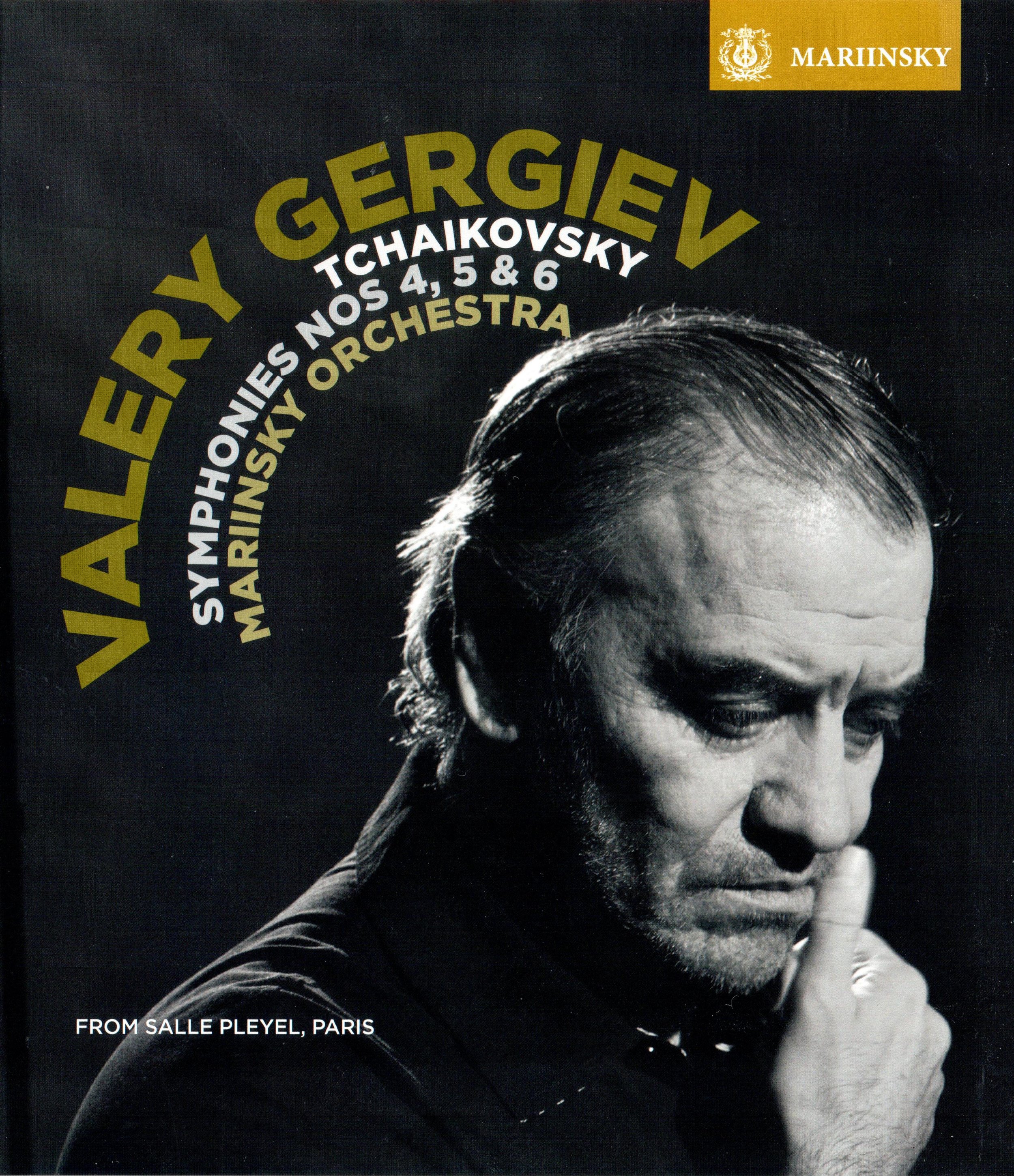
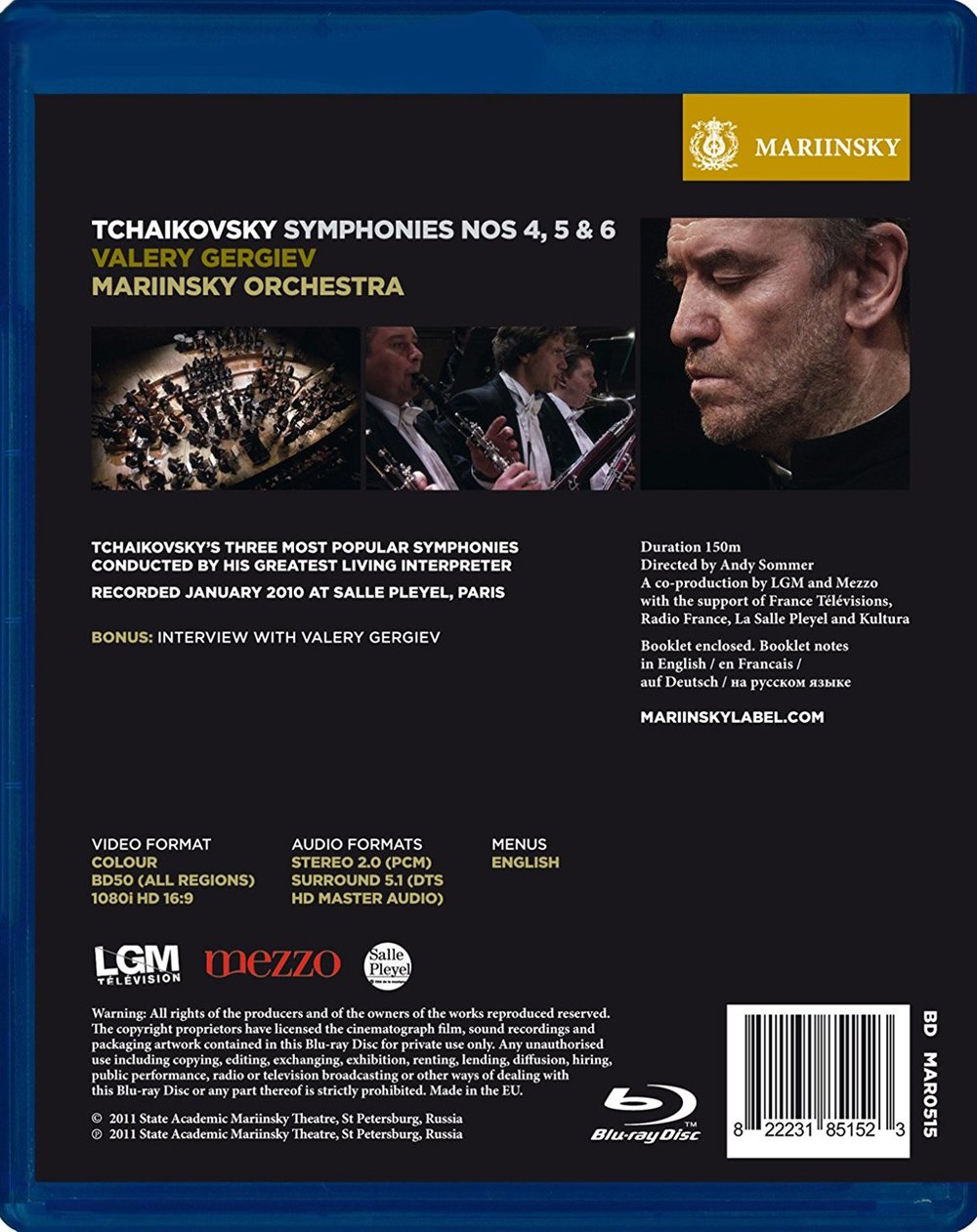
Tchaikovsky Symphonies Nos. 4-6


Tchaikovsky Symphonies Nos. 4-6. Valery Gergiev conducts the Mariinsky Orchestra in 2010 at Salle Pleyel in Paris. Three separate performances were directed for TV by Andy Sommer. Released 2011, disc has 5.1 dts-HD Master Audio sound. For all three tites: Grade: F

The musical performances at Salle Pleyel were probably quite enjoyable to the audience. But the SQ of the recording is poor compared to other HDVDs we have of the Tchaikovsky Symphony No. 6. Still, it's the video that tanks all three performances on this disc. I'll first describe in some detail the video recording of S4. The videos for S5 and S6 are similar with some differences I'll mention.

Tchaikovsky S4

The PQ of this Tchaikovsky S4 is almost astonishingly bad considering the fact that it was recorded in 2010. My theory is that the light at Salle Pleyel presented challenges the technicians could not overcome. Resolution is soft. Most frames are over-exposed, and the color balance is weirdly off with rose and yellow tones dominating. There is glare everywhere from the metal parts of instruments, the sheet music, and the white shirts. A white fog rises from the bottom of the picture from time to time. Many of the shots of the conductor have irritating motion artifacts. Many shots are plagued with focus and depth-of-focus issues.

Picture content is even worse than PQ because this video suffers from DVDitis with a wicked twist.

DVDitis is an illness that occurs when an HDVD is shot by folks who are used to making DVDs but don't know how to use high-definition TV cameras to make an HDVD. The main symptoms of DVDitis are lots of conductor shots used as a "hub" with many (easy-to-make) "spoke" shots of solo players, small groups of players, and instrument-only views, often in extreme close ups. In contrast to this, an HDVD with its high-definition pictures can present enjoyable views of large sections and especially the whole orchestra. (See our special article on standards for making a good HDVD of a symphony orchestra.)

The wicked twist here is that the Salle Pleyel supports a "spy cam" or mobile camera (probably on a wire) that looks down on the orchestra. This might sound like a useful capability. But as explained below, the spy cam just interferes with our enjoyment of the symphony.

The individual shots in this video are almost all very short. By the time the viewer gets oriented and is ready to enjoy a frame, a cut interferes and forces the viewer to focus on the next segment. There are no fewer that 73 conductor shots as the "hub" in this title. Then comes 53 instrument-only shots. There are 261 shots in the whole video. So already 48% of the video is accounted for without showing a player. Most of the rest of the video consists of shots of solos and small groups that can be done with close ups that look good on DVD. There are only 15 shots of whole sections and 15 shots of major parts of the orchestra.

That leaves us with about 20 whole orchestra shots. Of these, only 6 are traditional front-view, longer-range frames. The other 14 were made with the spy cam. When you see the whole orchestra from a seat in a theater, the group appears to be close together. When you see this from above with a spy cam, you realize that the orchestra a quite spread out. You are probably not used to this. The result is mental confusion and the need for time to get the images firmly in mind so you can observe and understand what you are seeing.  But hold the phone! Already the spy cam is moving about or zooming in or out, which further interferes with your efforts to grasp what is happening.

The result of all this is that I found it wearisome to have to watch this Tchaikovsky S4. Still, to be fair, I did note some good shots. See 7:05 for a nice view of the bass violins and the 1st violins. I also liked a shot of the trombones and tuba at 9:28 and two traditional shots of the entire horn section at 18:24 and !8:39. There were two good spy cam shots of the cellos and winds at 9:25 and 9:36. But on the other hand, see the totally inane spy cam shot at 9:02 looking straight down on the tops of heads of a group of strings.

Tchaikovsky S5

For this title, the color balance was grayed down to a "sepia" look, possibly in a (substantially unsuccessful) effort to get rid of glare. I get the impression management was fiddling with the lights, and that the result was even more "hot spots" than before.

Tchaikovsky S6

Yet another change in color balance provides a "blue light" on the orchestra. Most other color is drained out. This may reduce glare a bit and resolution appears to be improved. But the musicians now all look quite grim—like characters in a horror movie where the "undead" play a symphony for an audience of seated frozen corpses. (See 1:51:47 for the corpses.) At 2:09:57 there is something new—a freeze frame of Gergiev's face. See 2:22:01 to 2:22:04 for a short segment where nothing is in focus. Finally, for maybe the worst shot ever published on an HDVD, see between 2:13:32 and 2:13:33. A camera was left on for a split-second while it was turned to the next subject in the shooting plan. You see 22 smeared shots (22 of 30 frames in a second) before the camera stops. This is a "blooper" rather than a weak shot. It should have been caught by the editor or later by whoever is in charge of quality control at Mariinsky.

Now for a grade: for weak sound, we go from an A+ to B. For bad PQ and video content, we drop from B to D.  Finally, the poorly deployed spy cam and lack of quality control by Mariinsky leaves us with an F—this disc should have been abandoned and not sold to the public.

Below is a high-quality YT clip that clearly shows the DVD-like video content of this disc. However, the clip does not reveal the PQ issues I raise. But I have seen this title on 3 different high quality HT displays displays. Somehow the publisher managed to clean up the video on the YouTube segment, which I consider to be something like false advertisement. I wish the Blu-ray recording had been made with the same degree of care as this official clip:

OR

Music Is the Language of the Heart and Soul: A Portrait of Mariss Jansons and Mahler Symphony No. 2

Music Is the Language of the Heart and Soul: A Portrait of Mariss Jansons and Mahler Symphony No. 2. Here's the content:

1. Portrait of Mariss Jansons. Documentary by film maker Robert Neumüller on the life and career of Mariss Jansons. Produced by Felix Breisach; camera by Robert Neumüller.

2. Mahler Symphony No. 2 with Jansons conducting the Concertgebouw Orchestra and the Netherlands Radio Choir in 2009 in Amsterdam. Ricarda Merbeth sings soprano and Bernarda Fink is the mezzo-soprano. Directed for TV by Joost Honselaar; camera by Marlies Puijk; lighting by Pascal Naber; sound by Everett Porter; edited by Ronald be Beer; produced by Ronald Kok.

Released 2012, the documentary has stereo and the concert has 5.0 dts-HD Master Audio sound. Grade: C-


Read More

Takemitsu From me flows what you call time and Shostakovitch Symphony No. 5

Takemitsu From me flows what you call time and Shostakovitch Symphony No. 5. Yutaka Sado conducts his debut with the Berliner Philharmoniker in 2011 at the Berlin Philharmonie. The Takemitsu piece features the entire percussion section of the Philharmoniker:  Raphael Haeger, Simon Rössler, Franz Schindlbeck, and Jan Schlichte with Wieland Welzel (one of the timpani players). Directed for TV by Michael Beyer; produced by Grete Liffers. This disc may be restricted to Region A. Released 2011, disc has 5.1 dts-HD Master Audio sound. Grade: B+ for the Takemitsu  Grade: C+ for the Shostakovich

This was a special performance to raise relief funds for the people of Japan following the earthquakes and tsunami of March 2011. We already published a review of the EuroArts version of this title, and the grades shown here come from EuroArts review. Please refer to that review for more information.

This Japanese market version of the title appears from product descriptions on the Internet to have exactly the same music as that published by Euroarts. The difference would be, of course, other artwork and package information written in Japanese. It also appears that the sound on this recording, while excellent by general consumer standards, was not recorded with 96kHz/24 bit technology that is often used by NHK. So this would not be one of the audiophile recordings we have been enjoying from NHK.

Purchase from Amazon Japan.

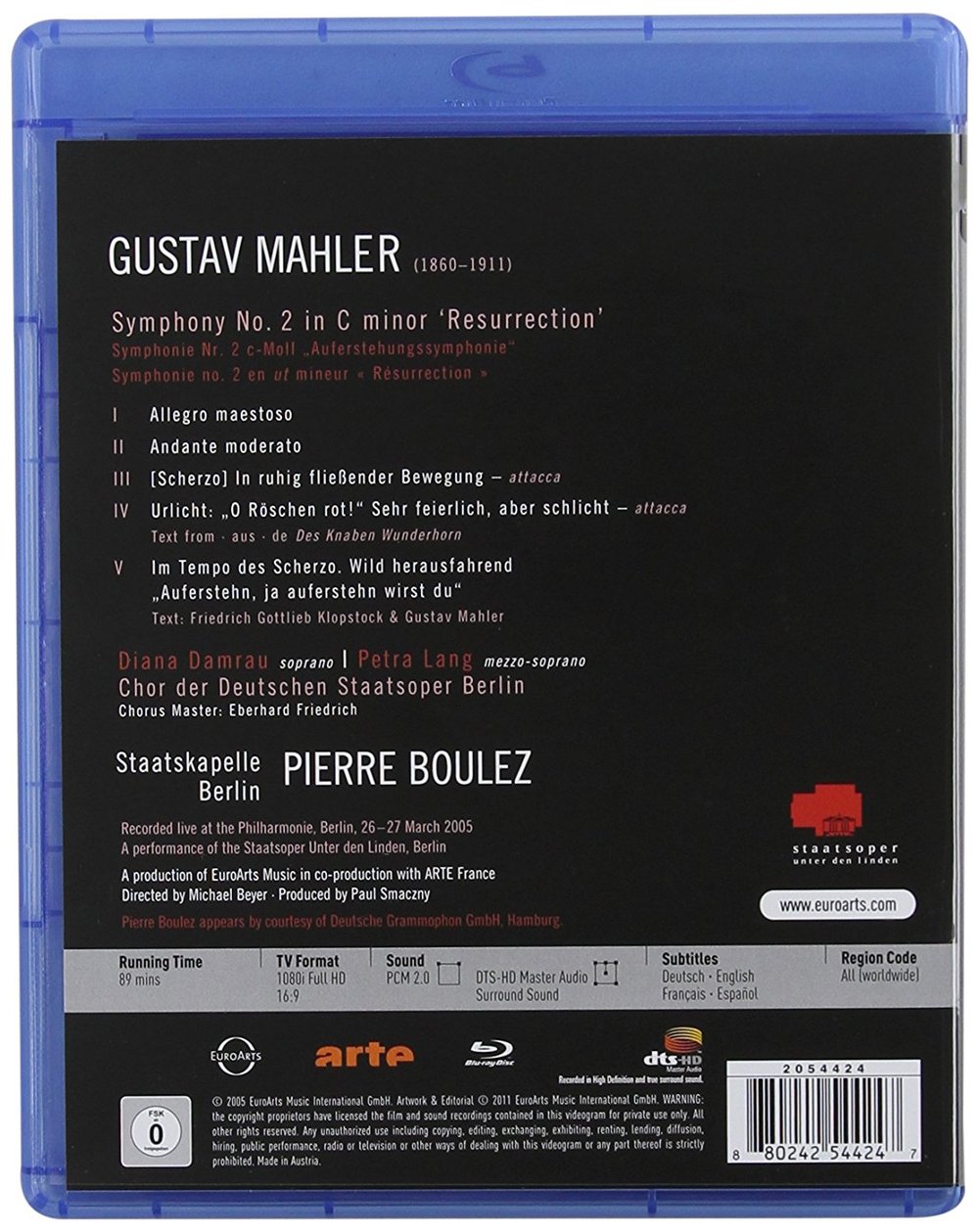
Mahler Symphony No. 2


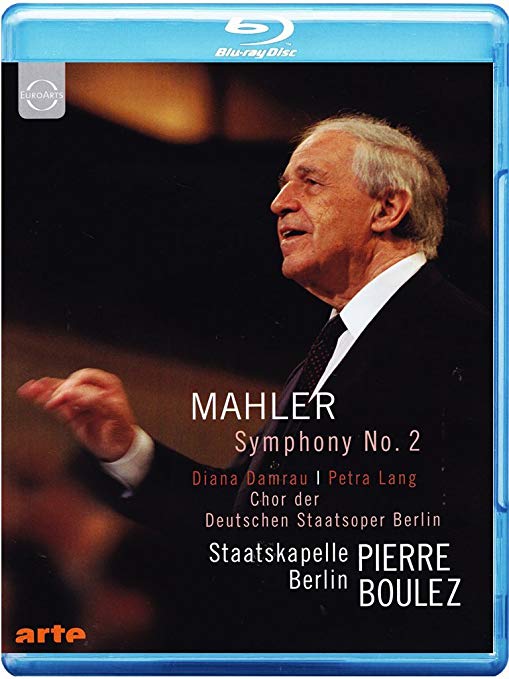
a terminal case of DVDitisMahler Symphony No. 2. Pierre Boulez conducts the Berlin Staatskapelle and the Chor der Deutschen Staatsoper Berlin in 2005. Soloists are Diana Damrau (soprano) and Petra Lang (mezzo-soprano). Released 2011, this disc has 5.1 dts Master Audio sound. Grade: D

This was recorded in Berlin at the home of the Berliner Philharmoniker. Pierre Boulez was guest conductor for this performance honoring his 80th birthday. If it turns out that God is a woman, then She will probably look like Petra Lang singing here. This is the Blu-ray version of the same title that came out on HD DVD back in the days when the "format war" was still going on.

This was the first symphony disc to come out in HDVD. In the early days, you could make a case that this was among the best classical music records ever made. But we watched it again in December 2017. The resolution is soft, Sa terminal case of DVDitisQ is weak with tubby base and other deficiencies in making and mixing,  the performance was a bit wooden, and the Blu-ray version is missing subtitles for the singing. The worst defect, however, is a terminal case of DVDitis with a fast pace, few large-scale shots, a huge number of shots of Boulez (the birthday boy), many instrument-only shots, etc. So today this title is not competitive in any way. Except maybe one: when you see Lang and Diana Damrau singing here, you will be convinced that these gals will make to heaven for sure.

Below is a YT clip with Lang and Damrau singing a bit:

OR

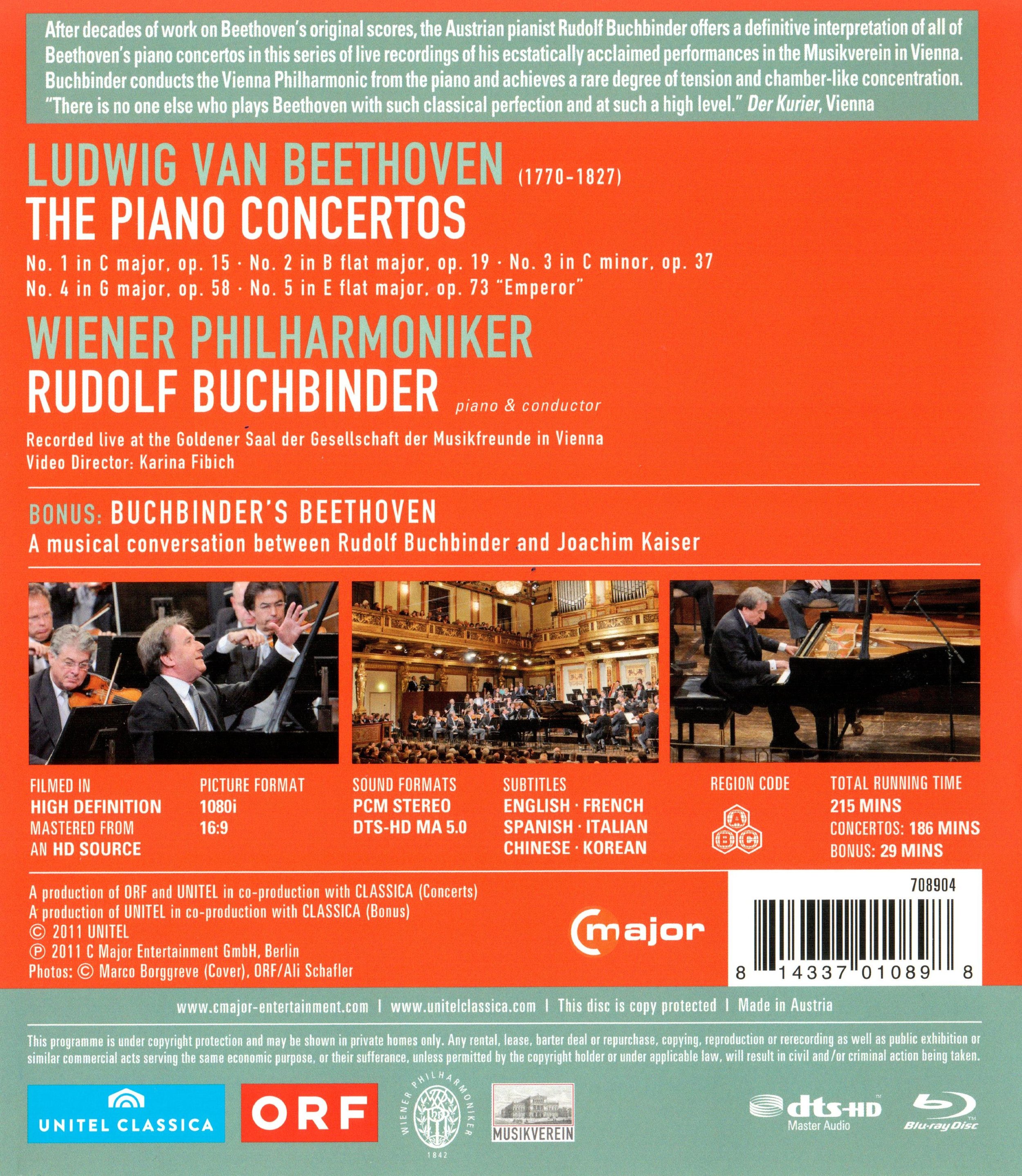
Beethoven Piano Concertos 1-5


Beethoven Piano Concertos 1-5. In 2011, Rudolph Buchbinder plays piano and conducts the Wiener Philharmoniker in all 5 Beethoven piano concertos at the Vienna Musikverein. The concerts were recorded live over 4 days. There are 186 minutes of music plus a bonus 30-minute documentary with a conversation between Buchbinder and music critic Joachim Kaiser. Directed for TV by Karina Fibich; video editing by Thomas König;  audio by Martin Gamperl. Released 2012, disc has 5.0 dts-HD Master Audio sound. Grade: C+

This title competes with the Barenboim 5 Beethoven Piano Concertos, which was recorded 4 years earlier in 2007. As you might expect of something recorded more recently, the picture quality is better than in the Barenboim issue. The sound quality is also better than the competition even if it is not audiophile sound beginning with 96kHz/24 bit sound sampling, etc. Finally, we think Buchbinder outplays Barenboim in these concertos. Buchbinder is a highly esteemed musician and scholar who has specialized in Beethoven; this qives him an edge here even over universal genius Barenboim.

It may have been the dream of a lifetime for Buchbinder to record these concertos at the Musikverein with the Wiener Philharmoniker for HDVD. If so, the dream collapsed into a bit of a nightmare due to worse than mediocre video content. This title was published simultaneously in DVD and HDVD.  And, alas, subject HDVD has a harsh case of "DVDitis."

DVDitis is a disease that affects HDVDs when the show was shot to be published as a DVD as well as in high-definition. The low resolution of DVD requires the TV director to rely primarily on close-up shots where the lack of resolution will not be noticed by the customer. So if you have to shoot for DVD, you can't use many shots of large sections of the orchestra or the whole orchestra. The typical DVD consists of a great many shots of the conductor cut quickly to close-up shots of one or two players in a frantic effort (think movie cartoon) to keep the show interesting. If the TV director is required to present the show in high-definition video with the same content required for the DVD, the result will be a bad HDVD. That is what likely has happen here.

The chief hallmarks of a good HDVD are (1) lots of whole-orchestra shots, (2) a moderate pace of video cuts that gives the viewer plenty of time to enjoy each shot, and (3) the use of close-ups only when they add significant value. All of this is turned upside down by Fibich and König in this Buchbinder title.

Let's look more closely at the recording of Piano Concerto No. 1. There is almost no effort in this video to show the entire orchestra or most of the orchestra. We count 285 cuts in a piece lasting 37 minutes. That's about 7.7 seconds per view, which is too fast. (Contrast this to the pace of about 14.5 seconds per view in the Murray Perahia Schumann Piano Concerto, which we consider our model for an HDVD of a concerto). Finally, subject video consists almost entirely of close ups as the video hot-potato gets passed around interminably.

An additional video defect is the almost perverse tendency of Fibich and König to shoot frequently from the rear of the orchestra showing the backs of the orchestra musicians. Additional errors are 16 inane instrument-only shots, dumb shots of the top of the tympani player's head, silly reflections of Buchbinder's hands in the shiny dust cover of the piano, and too much panning and zooming around. These stunts might seem clever in DVD where the videographer is always  looking for something new to amuse the viewer; they are repulsive in HDVD, where the viewer is always looking for something of timeless beauty.

Theses observations about Concerto No. 1 apply equally to the rest of the concertos in this series except that (1) picture quality is not consistently as good throughout as it is in Concerto No. 1 and (2) the pace of cuts is somewhat slower and more enjoyable in the highly lyrical Concerto No. 4.

Stephen Plaistow reviewed this set (apparently in DVD) on page 40 of the June 2012 issue of Gramophone. Plaistow dislikes Buchbinder's decision to direct as well as perform on the grounds that these concertos are too big and complicated to be played as chamber music. He also views Buchbinder as a scholar and technician rather than as an interpreter. As to the video, Plaistow concludes, "I doubt I'll be listening and watching again."

We feel sorry for Buchbinder. He appears to be a delightful man and a fine musician. We think these performances were successful live. Buchbinder probably had hopes (with good reasons from his perspective) that the recordings would be a hit. Alas, we fear these hopes were dashed by weak video content. And this bad video probably had a lot to do with Plaistow's prediction that he would not watch these concertos again. Other musicians and TV directors will eventually make wonderful recordings of these concertos taking full advantage of HDVD. But the opportunity to watch Buchbinder do this is probably lost forever.

Now to a grade. We are marking grades down substantially for bad video content. The Buchbinder disc also lacks  audiophile level sound and PQ is spotty. So we wind up with a grade of C+.

OR

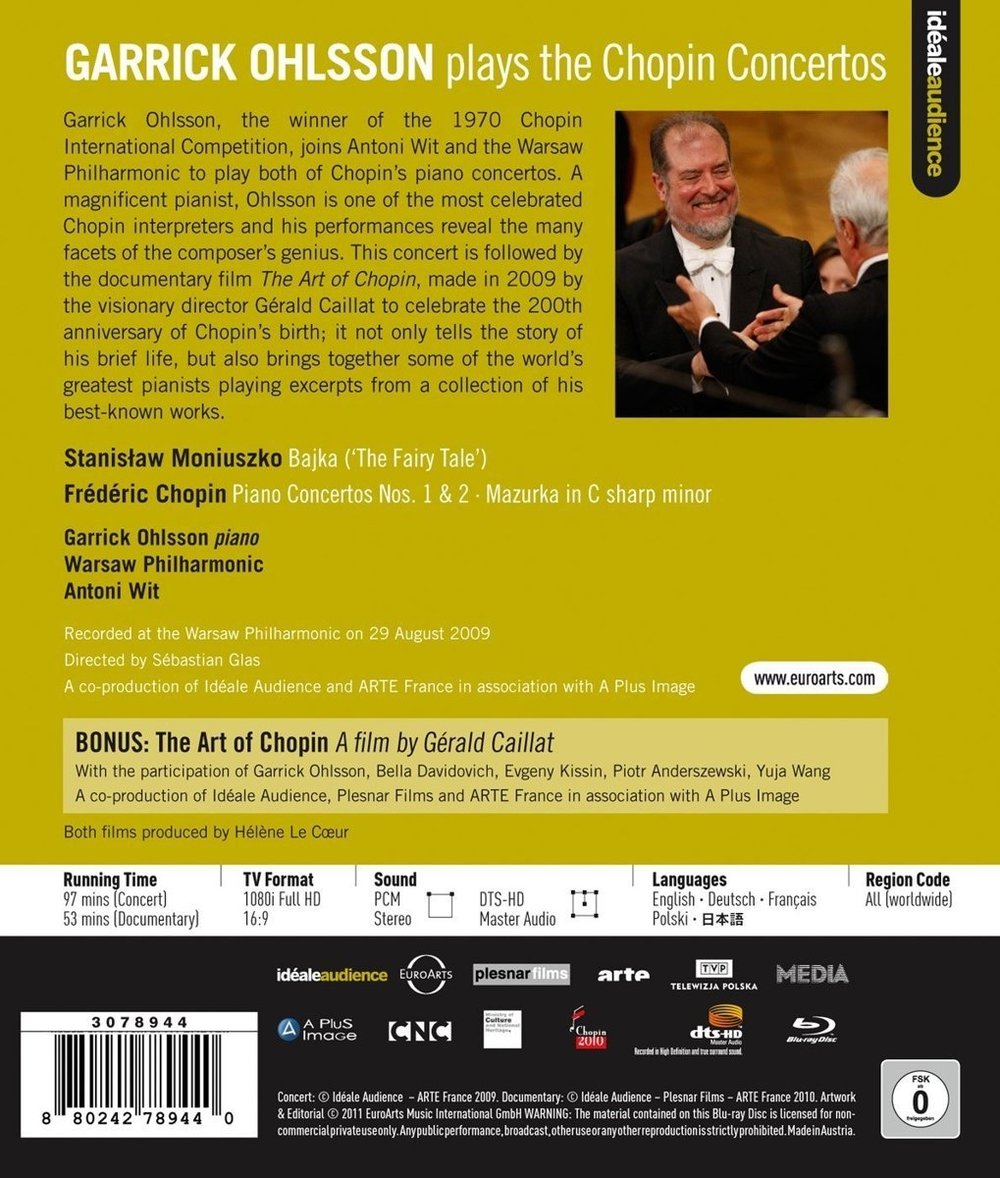
Chopin Piano Concertos 1 & 2


This 2009 Chopin piano concertos program has the following music:

  • The Warsaw Philharmonic Orchestra plays Bajka (Fairy Tale) by Stanisław Moniuszko.

  • Garrick Ohlsson plays the Chopin Piano Concerto No. 1

  • Ohlsson plays the Chopin Piano Concerto No. 2

  • Ohlsson plays as encore the Chopin Mazurka in C sharp minor

In addition, the disc has a 53-minute documentary, The Art of Chopin: A Film by Gérald Caillat.

 Antoni Wit conducts the Warsaw Philharmonic Orchestra at the Warsaw Philharmonic Hall. Directed for TV by Sébastian Glas; photography was directed by Thierry Houlette; sound was recorded and edited by Andrzej Sasin. Produced by Hélène Le Cœur. Released 1011, disc has 5.1 dts-HD Master Audio sound. Grade: C+

Let's start with comments that apply to the entire live performance. Thanks to Andrzej Sasin, sound quality throughout is competitive with most of the better HDVDs coming out now (other than audiophile recordings from publishers like NHK and AIX). Picture quality, however, is sub-par with poor resolution, a grainy appearance, color balance making folks look a bit too pink, and some motion artifacts. But what really drags this title down is amateurish video content, which we will discuss in detail.

Bajka (Fairy Tale)

We have commented often on our standards for a good HDVD of a symphony performance. The basic idea is to use the power of high-definition cameras to make video images showing much or all of the orchestra and Alas, so many YT clips: so few worth watching.to move in for close-up shots only when there are good reasons. This gives the viewer an experience similar to a spectator at a live performance enhanced with a reasonable number of close-up shots. You can't do this with low-resolution DVD pictures. DVDs therefore tend to present a long string of cuts from one close-up to another in a manner often reminiscent of a cartoon chase. Too often the TV director shoots a DVD and it gets published also as an HDVD because the producer doesn't know how an HDVD should look. When this happens,  we will call it to your attention.

The Bajka video is pure DVD. In about 14 minutes there are 155 cuts (that's a lot of action). There are 47 shots of the conductor and 26 close-up shots of instruments only — typical DVD fare. Most of the rest of the show is a  series of back-and-forth views from the conductor to the ghostly instruments, to soloists, or to small groups of players.  No attention is given to sections in the orchestra. There are only a few attempts to show most or a substantial part of the band. Most of these shots are from the side showing the backs of many musicians.

Alas, so many YT clips: so few worth watching.Because the action is so fast paced, the cameramen don't have time to set up their shots well. There's an astonishing number of shots with framing, focus, and field-of-focus issues. See for examples :41 where the camera is too low. In :53, 5:06, and 5:21 see framing and focus problems. At 5:34 the only person in focus is not playing while all the persons playing are out-of-focus.  The most dumbfounding shots are 2:02, 2:21, and 2:30 where the center of attention is the back of a music stand. All this video mayhem taxes the viewers' minds and interferes with appreciation of the music. The grade for this Bajka segment, were we to give one, would have to be a F.

Piano Concerto No. 1

This is another pure DVD. There were only 3 brief efforts during this concerto to show the whole orchestra, and at least of them is ruined because the camera was too low. There are a few part-orchestra shots, mostly made from the side showing the backs of many players. We noted only one effort to shoot any strings as a section. Then there is a flabbergasting 295 shots of the soloist (sometimes with 2 or 3 different views in one keyboard run). There are way too many shots of the conducAlas, so many YT clips: so few worth watching.tor (many made over the backs of the orchestra). The conductor shots are used as a hub with spokes out to solos, ghost instruments without visible players, and small groups of musicians. There are many views with gross framing, focus, and field-of-focus errors; see examples at 17:10, 25:09, 25:12, 25:30, 20:31, 29:37, 42:43, 53:28. At 23:12 and 23:31 there were even shots of the conductor's belly.

All this is a bit of a tragedy because Ohlsson's performance is so smooth, elegant, and flawless. He is more animated than and more graceful than Barenboim in his recent HDVD readings of Concerto No. 1.

Piano Concerto No. 2

The video content on this track is pretty much the same as on the recording of Concerto No. 1. There is no whole-orchestra shot at all. The pace of cuts is somewhat slowed, but there is still way too much going on to distract the viewer.

The Art of Chopin: A Film by Gérald Caillat

Alas, so many YT clips: so few worth watching.This is a pleasant presentation of Chopin's career with tons of legacy and modern footage of Ohlsson and other famous pianists chopining. It adds something of value to this otherwise disappointing disc.

Let's sum up.  It's sad that we now have 3 HDVDs of the Chopin concertos, but none of the discs do justice to the artists who performed. Now that we have high-definition TV, we have the ability to produce wonderful new video recordings. But the industry must learn how to use the high-definition cameras properly and leave behind bad DVD habits.

Both Ohlson performances had the potential for A+grades. But bad PQ and miserable video content knock this disc down two grades. The nice documentary offsets the total-loss Bajka number. So we wind up with the grade of C+.